










Supplier relationship management, or SRM, is the discipline of determining which supplier relationships have the greatest business impact, what depth of collaboration each warrants, how performance and risk are governed, and how the buyer and supplier create value together over time.
In most industries, that means onboarding, qualification, performance management, and collaboration across the supplier lifecycle. Electronics, however, adds a complication no other industry has to the same degree: the “supplier” is inseparable from a specific manufacturer part number, an approved manufacturer list, a package outline, a process change notice, a country-of-origin footprint, and an end-of-life timeline.
Electronics SRM therefore sits at the intersection of procurement, quality, component engineering, compliance, and operations. For a mid-size manufacturer, it has to hold together across 300 or more active suppliers; at larger EMS companies, well past 1,000.
One distinction is worth fixing at the outset:
Supplier management — the broad operating system for maintaining and governing all suppliers
Supplier relationship management — the strategic, value-focused layer for the suppliers whose technology roadmaps, allocations, quality performance, and lifecycle decisions can materially affect revenue and product continuity
A direct-materials base always contains both hundreds of low-touch transactional sources and a much smaller set that no manufacturer can afford to manage by email and gut feel.
This guide covers how SRM works in electronics manufacturing: how companies segment suppliers, run the supplier lifecycle from onboarding to exit, structure scorecards, negotiate for continuity rather than unit price alone, manage authorized versus independent channels, and connect supplier data to sourcing systems and inventory models.
The through-line: risk attaches to individual components, manufacturing sites, and lifecycle events within the bill of materials — so the relationships that govern them cannot live solely within purchasing.
What SRM is in practice
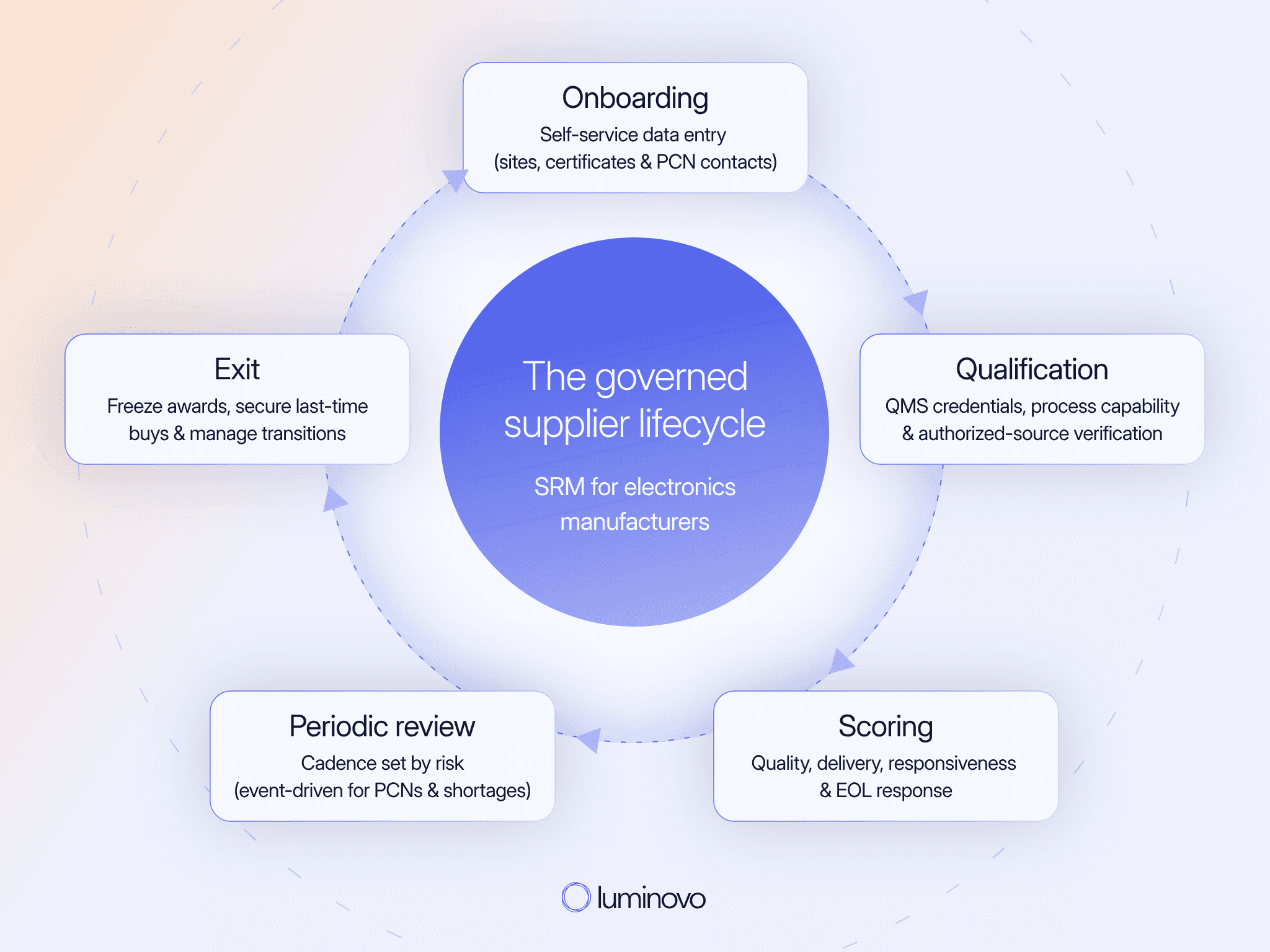
At an operating level, SRM is best understood as a governed supplier lifecycle: discovery, qualification and onboarding, ongoing maintenance, performance management, and eventual exit or obsolescence, run as one connected process with clear ownership at every stage.
A mature SRM program combines process, data, ownership, and systems so a manufacturer can decide whom to trust, how much to buy, which risks to accept, how to escalate problems, and when to redesign, dual-source, or exit a relationship — a standing capability, where a quarterly scorecard meeting is only the visible surface.
For electronics manufacturers, the program should be defined around direct-material continuity and product lifecycle outcomes, and the questions that decide outcomes are rarely limited to price:
Can the supplier hold form-fit-function stability?
Are parts flowing through the authorized channel?
Will process changes be communicated early enough to requalify?
Will the supplier help bridge an end-of-life event?
Can the buyer see far enough into sub-tier and site risk to avoid a line-down?
JEDEC, ECIA, and the supplier manuals of large electronics manufacturers all treat change notification, traceability, quality-system discipline, and sub-tier controls as part of the core operating model.
In practice, most electronics manufacturers run three supplier relationship modes side by side: transactional, strategic, and integrated. Then, they deepen a relationship only where the business impact justifies the investment.
McKinsey’s supplier-collaboration research ties the deeper end of this spectrum — strategic and integrated relationships — to superior growth, lower operating costs, and greater profitability. That depth comes at a price: governance, cross-functional engagement, and long-term commitment. It is exactly why deep collaboration is reserved for the suppliers that warrant it.
Why supplier relationship management is critical for electronics manufacturers
Electronics is unusually SRM-intensive because the operational risks associated with suppliers are tightly connected to specific components, lifecycle transitions, compliance obligations, counterfeit exposure, and engineering dependencies.
Small parts can create outsized business risk
The U.S. Department of Commerce’s semiconductor supply chain inquiry found demand significantly above pre-COVID levels and documented how limited inventories and extended lead times make supply disruptions more acute.
The pressure has not eased since: the Global Electronics Association’s monthly sentiment reports show material cost pressures intensifying through 2026 — reaching their highest levels since 2022 by June. Electronics makers, therefore, cannot treat suppliers as interchangeable vendors; they must actively manage continuity, prioritization, and response speed across a volatile component base.
For a mid-size electronics manufacturer, this is everyday operating reality: the direct-material base easily runs past 300 active suppliers, each tied to parts with their own lifecycle states, compliance files, and allocation histories.
Component specificity & lifecycle fragility
A finished electromechanical or semiconductor-dependent product is built from manufacturer-specific part numbers with unique process histories, package outlines, parametric limits, reliability qualifications, and compliance declarations.
JEDEC and joint JEDEC/ECIA/IPC standards exist precisely because changes in product or process, and eventual discontinuance, must be communicated in a disciplined way. OCMs operationalize this through PCN/EOL systems and published lifecycle states (active, NRND, last-time-buy, obsolete) with change notification governed by J-STD-046.
For an electronics manufacturer, that means SRM is inseparable from obsolescence planning, redesign management, and engineering change control.
Counterfeit & traceability exposure
ECIA’s guidance on sourcing outside the authorized channel is unambiguous: non-authorized channels cannot provide the same assurance of authenticity, warranty coverage, traceability, and documented, compliant handling.
DFARS 252.246-7007 goes further for defense-related buying by requiring a counterfeit electronic part detection and avoidance system, including inspection and testing, risk-based tracking from the original manufacturer, reporting, quarantine, subcontract flowdown, and control of obsolete parts.
Even outside defense, that regulatory logic captures a real operational truth for commercial electronics as well: once a company buys on the open market, the burden of proof and the cost of authentication shift back to the buyer.
Electronics SRM is also compliance-heavy. Direct-material suppliers frequently must support RoHS restrictions on hazardous substances, REACH Article 33/SVHC obligations, WEEE end-of-life responsibilities, U.S. conflict minerals disclosures, TSCA restrictions on certain PBT chemicals, and, in some channels, California Proposition 65 warning exposure.
The industry relies on structured declaration standards and templates because ad hoc email collection does not scale across multi-tier bills of material. IEC 62474 defines the procedure, content, and form for electrotechnical material declarations; IPC-1752 establishes a standard reporting format for material-declaration data exchange; RMI’s CMRT and EMRT exist to move mineral due diligence data through the supply chain.
A credible electronics SRM program, therefore, requires document governance, version control, supplier attestations, exception handling, and audit trails.
Innovation & NPI support
Finally, electronics companies depend on suppliers for innovation and New Product Introduction (NPI) support, not only availability.
Mouser positions itself around rapid introduction of new products from authorized manufacturers; TT Electronics markets NPI engineering support from design validation through pilot production; Gartner’s scorecard framework says supplier evaluation should include service responsiveness, innovation capabilities, and the ability to support new product introductions.
Especially in industrial, medical, automotive, aerospace, and infrastructure electronics, the supplier base shapes time-to-market, manufacturability, and redesign speed.
📊 Build resilience into your supply chain
Evaluate alternates, assign actions, and track mitigation strategies in one place.
👉 Strengthen your supply chain
Supplier segmentation for electronics manufacturers
The most practical segmentation model for electronics combines relationship segmentation and channel segmentation.
On the relationship side, suppliers should be segmented by supply risk and business impact, with different governance for routine, leverage, bottleneck, and strategic categories. Strategic suppliers are the natural candidates for deeper SRM because the cost of a failure is high and substitution is hard.
The segmentation logic goes back to Kraljic’s purchasing portfolio model (HBR, 1983). In electronics, that usually means one supplier can be “transactional” for one category and effectively “strategic” for another if the part is unique, qualified, allocated, or embedded in a high-revenue product line.
On the relationship-depth side, most electronics manufacturers run three SRM modes side by side:
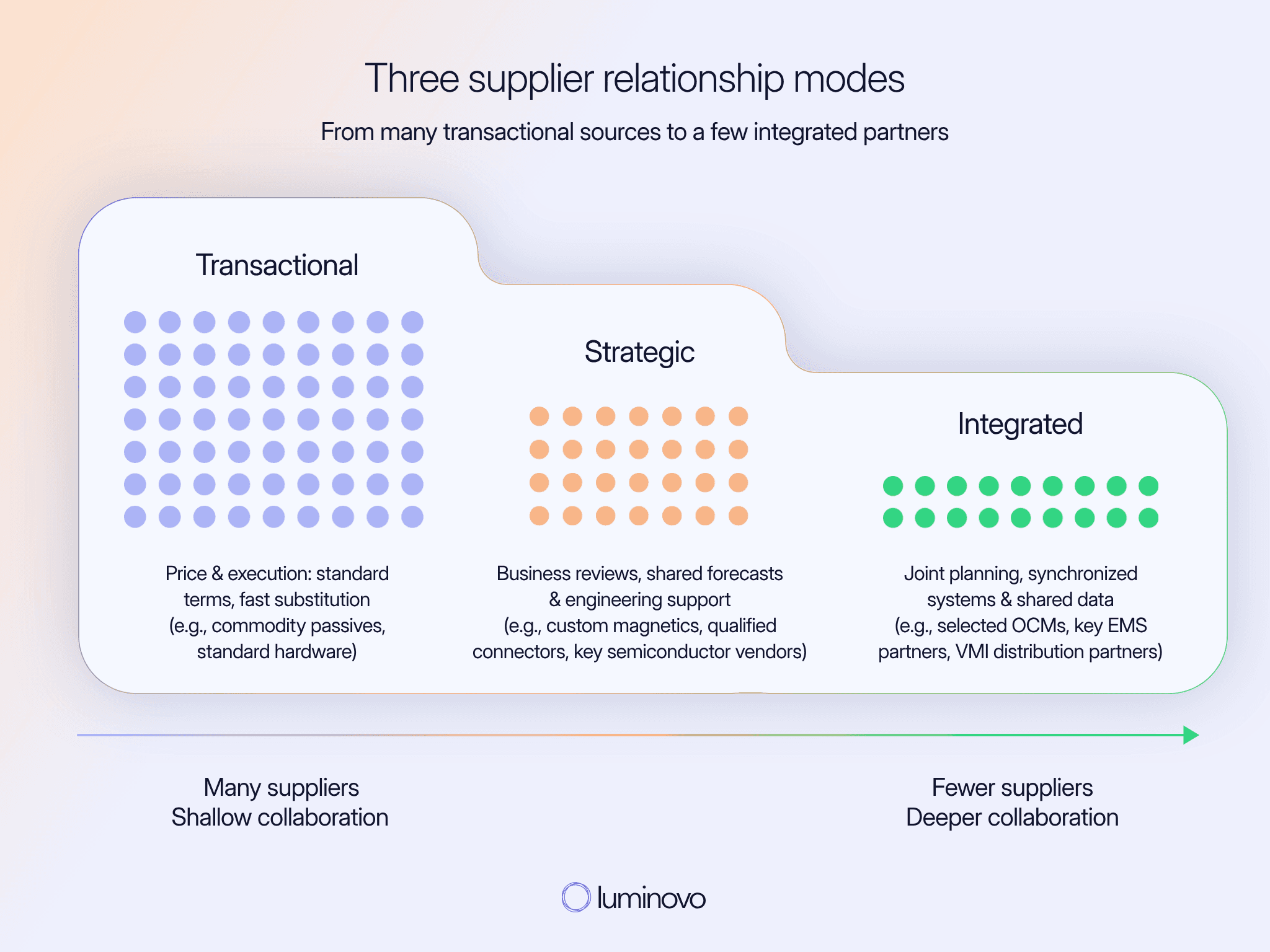
Mode | Focus | Electronics examples | Governance |
|---|---|---|---|
Transactional | Price & execution: standard terms, fast substitution if performance slips | Commodity passives, standard hardware, low-risk MRO | Price compliance, on-time delivery, administrative efficiency |
Strategic | Business reviews, shared forecasts, engineering support & structured improvement plans | Custom magnetics, safety-qualified connectors, specialist PCB houses, key semiconductor vendors, test houses | Joint business planning, compliance discipline, continuity |
Integrated | Joint planning, synchronized systems & shared data across the value chain | Selected OCMs, key EMS partners, distribution partners running bonded inventory or VMI | Embedded in the manufacturer’s own planning process |
Channel segmentation is just as important as relationship segmentation.
An OCM, or original component manufacturer, is the organization that designs or engineers the part and owns the IP behind it. DFARS defines it, and the OCM is the authoritative source for lifecycle status, qualification data, PCNs, Product Discontinuance Notices (PDNs), and warranty policy.
In semiconductor-heavy categories, the OCM is the ultimate source of truth for form-fit-function, fab or assembly changes, package changes, last-time-buy windows, and authorized-channel status. SRM with OCMs therefore matters even when the commercial transaction actually flows through distribution.
An authorized or franchised distributor has a contractual relationship with the manufacturer for the relevant line and geography. ECIA states that the authorized channel assures authenticity, traceability, warranty, and compliance handling.
DigiKey states that it is an authorized distributor for more than 3,000 suppliers and that products come directly from the manufacturer; Mouser describes itself as a global factory-authorized distributor and an ECIA authorized distributor; TrustedParts, which ECIA created, aggregates only authorized inventory and verifies authorization status.
For SRM purposes, authorized distribution is the preferred default channel for commercial electronics.
Among the distributors named, it is useful to differentiate between high-service catalog distribution and broadline/global fulfillment distribution rather than pretending all Tier 1 distributors operate identically.
For example, DigiKey and Mouser are especially strong in design-stage access, long-tail availability, rapid shipping, and digital product data. Arrow and Avnet also cover catalog buying, but built their models around large-program procurement, customer-specific pricing, supply chain services, and enterprise integration.
Arrow and Avnet both market supply-chain solutions and procurement APIs. In practical SRM terms, all four can be “Tier 1” counterparts, and the best channel mix depends on whether the problem is prototype velocity, line-item breadth, volume allocation, global logistics, or digital integration.
The channel decision doesn’t have to become an infrastructure decision, though: Luminovo connects to all four, so pricing, availability, and order data land in the same sourcing workflow, regardless of the mix a team runs.
An independent distributor or broker operates outside normal OCM authorization. ERAI defines an independent distributor as one that buys parts for resale, often from OEM or contract-manufacturer excess inventory or from other distributors, and notes that independent distributors do not normally have contractual agreements with OCMs.
ECIA’s authorized-channel guidance specifically names brokers and excess-inventory liquidators as companies operating outside the authorized channel. That does not mean they are always unusable.
It means the sourcing case must be exceptional and the controls must be materially stronger: enhanced authentication, chain-of-custody review, documented test plans, legal review, and executive approval thresholds. AS6081’s existence as a counterfeit-mitigation standard for distributors is itself evidence that open-market buying is a controlled-risk activity rather than a routine default.
An EMS channel should be treated as its own SRM category. Jabil markets procurement and supply chain services backed by large spend and tens of thousands of supplier relationships; Flex positions its global supply chain network as a resilience engine; Celestica likewise stresses supply chain and manufacturing expertise.
For OEMs, EMS partners may source components on a turnkey basis, build from consigned material, or operate under hybrid arrangements. That shifts SRM from a simple supplier-to-buyer relationship into a three-corner model involving the OEM, the EMS, and the underlying component sources.
The OEM’s SRM program therefore has to specify channel authority, approved sources, liability for shortages and substitutions, ownership of compliance documentation, and PCN/PDN routing.
How to run SRM in electronics: workflow, scorecards, risk & negotiation
The governed supplier lifecycle: five stages from onboarding to exit
An electronics SRM workflow that holds up in practice has five stages: onboarding, qualification, scoring, periodic review, and exit.
1. Onboarding
Onboarding should establish a clean supplier master, legal and tax identity, banking controls, contacts, facilities, products and services, code of conduct alignment, and required documents.
In electronics, onboarding should also capture authorized status, region served, manufacturing and ship-from sites, quality system certificates, ESD/MSL handling capabilities (where relevant), and contact points for PCNs, quality incidents, and compliance declarations.
Done by hand, this is where supplier teams lose the most time — collecting certificates, chasing declarations, and re-keying supplier data can absorb 60–80% of the effort that could otherwise go into supplier development. Structured, self-service onboarding gives most of that time back.
2. Qualification
Qualification should move past administrative completeness into capability verification.
Electronics supplier manuals show what this looks like in practice:
Kimball Electronics expects suppliers to meet quality-system requirements and flow requirements to sub-tier manufacturers
TT Electronics describes supplier approval, audits, Production Part Approval Process (PPAP) or First Article Inspection (FAI), and continuous improvement
TE Connectivity sets the expectation of defect-free product, delivered on time, at the agreed terms
For electronics makers, qualification usually needs to cover Quality Management System (QMS) credentials, process capability, first-article or PPAP requirements where appropriate, compliance-document readiness, counterfeit prevention, change-notification discipline, and — critically — whether the source is truly authorized for the parts being bought.
3. Scoring
Scoring should be periodic, weighted, and tied to consequences.
In electronics, scoring should not be based solely on Enterprise Resource Planning (ERP) receipt data. It should also pull from quality records, Supplier Corrective Action Request (SCAR) workflows, PCN response logs, lifecycle tools, and engineering feedback. That is the only way to capture the real health of a direct-material supplier.
4. Periodic review
Periodic review should occur at a cadence that risk warrants. Transactional or low-risk suppliers can often be managed through exception-based reviews. Strategic suppliers should normally have at least quarterly operational reviews and an annual business review.
In contrast, integrated suppliers often require monthly demand/commit meetings and event-driven reviews tied to PCNs, shortages, escapes, or compliance changes. Approvals need to remain valid — requalification triggered by process changes, site moves, or performance breaks, never “one and done.”
5. Exit
Exit should be a controlled process, because suppliers leave portfolios constantly — through discontinuance, consolidation, or performance failure.
A disciplined exit process should freeze new awards, review open Non-Cancellable Non-Refundable (NCNR) exposure, identify last-time-buy needs, capture replacement options, confirm document retention and traceability requirements, and coordinate redesign or dual-source transitions with engineering and customers.
Use scorecards that are electronics-specific
The most useful supplier scorecards in electronics are built around quality, delivery, responsiveness, price compliance, NPI support, and EOL response.
For quality, Parts Per Million (PPM) still matters, but it is not enough on its own. Kimball targets zero defects and 100% on-time delivery; TT Electronics tracks PPM, defect occurrences, SCARs, and PPAP timing; TE expects defect-free product.
A strong electronics scorecard should therefore include incoming PPM, line escapes, defect recurrence, containment speed, SCAR response time, and closure effectiveness. If product safety, regulated use, or mission assurance matters, the scorecard also needs evidence of traceability and counterfeit prevention, not just defect counts.
For on-time delivery (OTD), the key question is not only whether material arrived at the dock, but also whether the supplier met the committed date and quantity in a way that supported the factory build plan. Kimball and TT both set 100% on-time expectations, and TT shows that on-time delivery is often tied to accepted release schedules and narrow timing tolerances.
In semiconductor and connector categories, another useful electronics metric is commit reliability: how often the supplier reconfirms, pushes out, or partially commits after acknowledging demand. That metric is especially important during allocation.
For responsiveness, electronics buyers should track quote turnaround time, engineering question response time, quality response time, and acknowledgment behavior.
TT explicitly measures response timing on corrective actions; Gartner’s supplier scorecard guidance says scorecards should evaluate supplier service responsiveness and innovation capability.
In practice, the most revealing responsiveness metrics often include SCAR acknowledgment time, time to root-cause containment, time to resolve documentation gaps, and time to respond to PCNs or lifecycle notices.
Suppliers that answer quickly but close issues slowly should not receive the same score as suppliers that consistently restore control.
For price compliance, the important issue is not whether a quoted price looked attractive in a sourcing event, but whether the supplier actually maintained contract pricing, rebate logic, and agreed-upon escalators in live execution.
ADI’s terms reserve the right to adjust prices under certain conditions; Avnet’s terms make clear that NCNR and order acceptance are governed by contract; ECIA’s NCNR guidance emphasizes the clear identification and acknowledgment of NCNR products.
Electronics manufacturers should therefore track contract-price hit rate, PPV versus contracted tiers, unauthorized surcharges, and the share of buys made at spot rather than planned pricing. These are weak signals for either planning failure or poor supplier governance.
For NPI support, generic procurement scorecards are often too shallow. Gartner’s framework says supplier evaluation should include the ability to support new product introductions.
In electronics, that support includes sample availability, prototype responsiveness, DFM/DFT/DFSC feedback, alternate-part recommendations, PPAP or FAI timing where relevant, pilot-build discipline, and engineering engagement during ramp.
EMS and specialized manufacturers market NPI support precisely because it matters operationally. The scorecard should therefore include NPI lead time, prototype hit rate, first-build quality, and turnaround time for alternate parts for scarce components.
For EOL response, the scorecard should measure behavior before a shortage becomes a redesign crisis.
Because J-STD-046 governs timely customer notification of product/process changes, and because OCMs such as TI and Microchip publish lifecycle and PCN/EOL frameworks, suppliers can be assessed on whether they subscribe the right contacts, acknowledge notices promptly, propose alternates, support bridge buys, and coordinate change qualification.
In electronics, a supplier that consistently helps the manufacturer survive obsolescence is far more valuable than one that only ships well in stable periods.
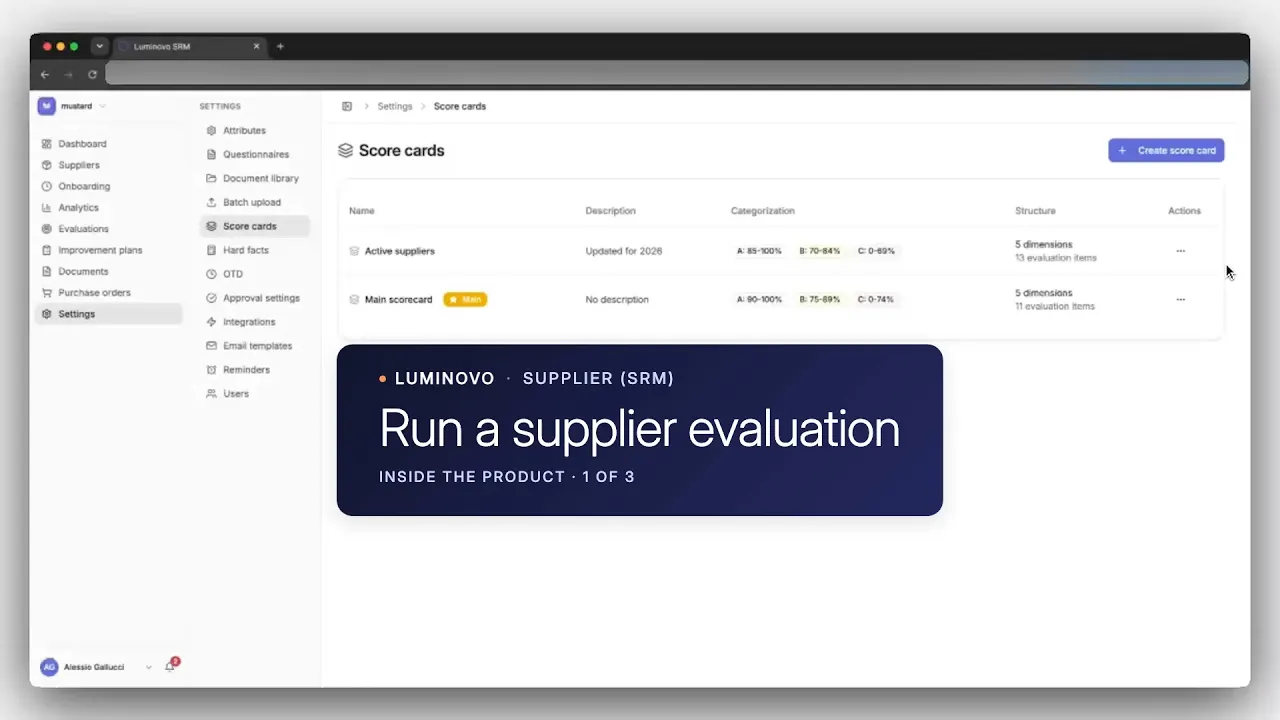
In this one-minute video, Mark Allen, one of the Solutions Engineers at Luminovo, runs a supplier evaluation in Luminovo Supplier (SRM), with each score traced back to the purchase orders, quality issues, and certificates behind it.
⚡ Supplier scorecards, without the spreadsheet
360° supplier performance — total spend, delivery, quality & quote responsiveness — built from your live sourcing data.
👉 Explore Luminovo SRM
Treat risk mitigation & compliance as SRM core work: four practices
SRM without risk and compliance discipline is incomplete, and in electronics the first gap is usually visibility. Four practices carry most of the weight.
1. Require sub-tier visibility where the risk warrants it
Visibility belongs at the level of the manufacturing site, country, smelter, and logistics lane rather than the supplier legal entity, because many “different” suppliers depend on the same fab, assembly house, substrate source, or port.
Deciding which suppliers, sites, and lifecycle events deserve that deeper monitoring is a supply chain risk question in its own right; SRM is where those risk signals turn into supplier decisions — segmentation changes, second sources, exit plans.
2. Default to the authorized channel
Define controlled exceptions for every other channel. ECIA’s guidance and TrustedParts’ verification model make clear that authorized distribution is the only route that reliably preserves traceability, warranty, and chain-of-custody assurance.
When shortages force reliance on independent sources, the policy should automatically escalate to enhanced testing, documentation review, quarantine, and approval controls. DFARS 252.246-7007 provides a strong template for what a serious counterfeit-avoidance system looks like even outside strictly regulated defense environments.
3. Use structured declarations & auditable templates
Compliance runs on structured declarations and auditable templates rather than email attachments and static spreadsheets. RoHS, REACH, WEEE, TSCA, conflict minerals, and certain customer- or channel-specific rules all impose ongoing obligations that change over time. IEC 62474 and IPC-1752 exist because the electrotechnical supply chain needs structured data exchange for materials and substances.
RMI’s CMRT and EMRT are similarly standardized so that due-diligence data can move across multiple tiers without each company inventing a private questionnaire. A mature SRM program uses these standards as system objects: documents with owners, effective dates, renewal rules, exception workflows, and escalation clocks.
4. Map compliance ownership by channel
OCMs are typically the authoritative source for product lifecycle and technical compliance data; authorized distributors may host or relay PCNs and declarations; EMS partners may collect supplier documents during turnkey procurement; but the OCM usually remains accountable to customers and regulators for what ships in the finished product.
That accountability split is why contracts and workflows must specify who subscribes to PCNs, who owns material declarations, who validates mineral templates, who maintains audit trails, and who funds testing when channel exceptions occur.
Negotiate the relationship, not only the unit price: three contract priorities
Supplier negotiations should focus as much on continuity and execution rights as on price. Unit cost matters, but so do the mechanics that determine who gets supply when capacity is tight.
The stakes justify the effort: electronics components are usually a manufacturer’s largest and most concentrated spend category, and a 5% cost improvement with key electronics suppliers can outweigh the savings available from entire other categories.
1. Clarity on NCNR, reschedule rights, forecasts & last-time-buy mechanics
Avnet’s terms state that NCNR orders are non-cancelable and non-returnable, that orders generally cannot be changed or rescheduled without consent, and that Avnet reserves the right to allocate product among customers.
Future Electronics’ NCNR language similarly treats the order as firm and non-reschedulable. TI PDN examples show that discontinuance often comes with a non-cancelable, non-refundable last-time-buy window.
In practice, this means an electronics manufacturer should negotiate forecast horizons, decommit windows, liability caps, and buffer-stock logic before shortages or PDNs occur, while there is still leverage to negotiate with.
2. A service level agreement with teeth
For electronics suppliers, the SLA should usually include at least:
PO acknowledgment timing
Commit reliability
On-time delivery
Quality targets and SCAR closure timing
PCN and obsolescence notification expectations
RMA and failure-analysis turnaround
Escalation contacts
NPI support obligations where engineering participation matters
Large electronics supplier manuals already operationalize many of these expectations, but turning them into contract-linked review criteria materially improves enforcement.
3. Realism about allocation guarantees
Allocation guarantees are rarely absolute unless backed by commercial mechanisms. What actually secures supply in constrained periods is a mix of accurate forecasts, bonded or buffer inventory, VMI or consignment setups, authorized-channel prioritization, scheduled orders, and sometimes volume commitments.
Arrow, Avnet, DigiKey, and Mouser all support digital procurement and order visibility; Jabil and Flex offer large-scale supply chain planning and procurement services. The real negotiation question is therefore: what data, commitments, and inventory structures are being exchanged for continuity?
Systems, data integration & software
Why systems integration matters
Electronics SRM becomes brittle when data lives in disconnected silos. Supplier master data may sit in ERP, qualification in a supplier portal, lifecycle status in a parts-intelligence tool, compliance files on a shared drive, and PCNs in distributor inboxes. Enterprise procurement suites all sell against this fragmentation by promising a central view of suppliers.
That baseline is necessary, but electronics companies usually need one more layer: part and BOM-level intelligence connected to the supplier record. Without that layer, the organization can know a supplier is “approved” while still missing the fact that a specific part is NRND, allocated, or noncompliant in a target geography.
Grossenbacher Systeme AG rebuilt its supplier management around this integrated model, treating supplier data as part of the sourcing workflow rather than as a parallel filing system.
EDI, API & MCP integration
For recurring procure-to-pay execution, Electronic Data Interchange (EDI) remains foundational. X12’s official definitions show the core message set: the 850 transmits purchase orders, the 855 acknowledges them, the 856 communicates shipment contents and manifests, and the 810 handles invoicing.
These are still the backbone of structured supplier execution in many enterprise environments because they are stable, governed, and well understood. For electronics manufacturers, EDI is particularly valuable where scheduled releases, ASNs, and dock/receipt synchronization are critical.
APIs matter because they provide real-time access that classic EDI often does not. DigiKey’s API portal supports product search, quotes, orders, order status, supply-chain inventory visibility, and product change notifications.
Mouser’s APIs provide access to product data, pricing, availability, cart, order, and order history. Arrow and Avnet both market procurement APIs for pricing, availability, lead times, customer-specific pricing, backlog status, and order integration. Those APIs are especially powerful when tied to BOM workflows, shortage dashboards, quote bots, and exception-management routines.
A balanced architecture usually uses both EDI and APIs. Arrow states that APIs and EDI complement each other: APIs enable real-time data exchange, while EDI adheres to established messaging standards. That is the right mental model for electronics manufacturers.
Use EDI for governed transaction flows with repeatable partner rules; use APIs for live price/stock/lead-time lookups, PCN monitoring, order-status exceptions, and engineering-procurement collaboration.
MCP integration is the newest element in the stack, and it should be treated as an emerging orchestration layer that sits alongside existing ERP controls. The official Model Context Protocol specification defines a JSON-RPC-based client-server pattern in which applications connect to servers that expose tools, resources, and prompts; the protocol supports transports such as stdio and HTTP and includes authorization models for restricted servers.
In SRM terms, that means a procurement or supply-chain system can expose controlled actions and structured supplier data to an AI agent without hard-coding one-off integrations for each assistant. In the near term, the safest use cases are read-only applications such as supplier risk summaries, PCN triage, compliance document lookup, or guided exception handling.
Transactional write actions should remain governed by the same approvals and audit trails as any other procurement system action.
Predictive analytics & electronics-specific tooling
Analytics earn their keep in SRM when they incorporate component lifecycle, supply-market, and site-risk data, not spend data alone. Parts-intelligence providers build predictive obsolescence analysis, BOM-level risk scoring, and compliance rollups for exactly this reason.
Generic SRM software typically excels at four areas: supplier master data, onboarding and qualification, performance and risk governance, and collaboration workflows. Electronics-specific tooling adds capabilities that generic suites usually lack or only weakly support: approved manufacturer and vendor lists; part-number cleansing and cross-reference; lifecycle and years-to-EOL signals; BOM risk and shortage analysis; PCN/PDN/EOL monitoring; distributor inventory and pricing feeds; compliance-declaration rollups; site and sub-tier risk mapping; and engineering-aware alternate-part logic.
When companies try to run direct-material electronics SRM from ERP alone, they usually end up rebuilding these capabilities with spreadsheets, email, and heroic tribal knowledge.
🔗 Unify your entire EMS supply chain
Connect suppliers, customers & internal teams on a single real-time platform.
👉 Discover the platform
Inventory models inside SRM
Inventory strategy is part of SRM because it determines how the buyer and supplier share ownership, visibility, forecast risk, and service expectations.
VMI puts replenishment planning in shared or supplier hands against agreed min/max logic. For electronics manufacturers, it works best with stable, repeatable demand — standard materials and components that are repeatedly consumed. It can reduce stockouts and buyer workload, but only if supplier data, usage data, and planning parameters stay accurate.
In a consignment arrangement, the supplier retains ownership until the buyer consumes the inventory. This model is common in electronics, especially when the buyer wants physical availability without taking immediate title, or when an EMS partner holds customer-owned material.
Consignment changes the commercial relationship: pricing, consumption triggers, liability, aging rules, and audit expectations all need to be explicit.
In JIT, Toyota’s own production-system materials describe Just-in-Time as one of the pillars of TPS and link it to waste reduction and synchronized flow.
For electronics, JIT is attractive because it reduces working capital and exposes quality problems faster, but it is also fragile during allocations, customs delays, fab interruptions, or sudden demand spikes. That fragility is why pure JIT is often too aggressive for long-lead semiconductors even when it works for more stable categories.
The most realistic electronics answer today is often a hybrid model. Strategic semiconductors or custom parts may need buffer stock, bonded inventory, consignment, or supplier-held safety stock; predictable standard parts may fit VMI; stable local flows may still use JIT.
That hybrid approach is an inference from the documented strengths and limits of VMI, consignment, JIT, and modern EMS procurement models. Still, it is consistent with how electronics firms actually balance resilience and working capital.
How TQ & Fluidra run supplier relationship management
The clearest way to see the difference between administrative supplier management and working SRM is in how electronics manufacturers run them day-to-day. TQ Group, a German E²MS provider with more than 1,000 active suppliers, rebuilt supplier onboarding around configurable self-service questionnaires: suppliers enter their own data, and procurement, accounting, legal, and supplier quality management work within a single shared process.
Audit preparation went from a targeted exercise to ad-hoc readiness, and 100% of suppliers onboarded so far have accepted the new process — a meaningful adoption signal in an industry where supplier portals often die quietly.
Managing supplier relationships and quoting processes within the same ecosystem – that just made so much more sense to us.
— Christian Gerland, Head of Procurement at TQ Group
The OEM version of the same discipline looks different. For a design OEM like Fluidra, component choices made at the NPI stage lock in Tier-2 supplier relationships for years, so supplier development is treated as work the procurement team cannot delegate — grounded in segmentation logic and a measurable data foundation rather than relationship instinct.
Sourcing + SRM: the full procurement lifecycle
Most SRM tools sit apart from the systems where buying actually happens. Supplier records live in one platform, RFQs and sourcing decisions in another, and someone reconciles the two in a spreadsheet before the quarterly review.
The supplier data may be accurate, but it arrives after the fact — it describes relationships without informing the next award decision.
The alternative is to run supplier management inside the sourcing platform itself. This is the approach behind Luminovo’s SRM, which is built into the same platform that handles electronics sourcing: delivery reliability, quote responsiveness, and quality history accumulate as by-products of daily sourcing work and feed back into strategic sourcing decisions, category strategy, and negotiations without any re-keying.
Connected this way, the two disciplines cover the full procurement lifecycle. Sourcing decides which offers to take today; supplier relationship management decides which suppliers earn the business over time — and each decision improves the data behind the other.
Key takeaways
Electronics SRM is fundamentally different from generic supplier management because supplier risk is tied directly to specific manufacturer part numbers, lifecycle states, engineering dependencies, compliance obligations, and production continuity.
Effective electronics SRM is cross-functional — procurement, engineering, quality, compliance, and operations all govern supplier relationships and component risk, with transactional, strategic, and integrated suppliers each governed differently.
Authorized distribution channels provide significant advantages in traceability, authenticity, warranty support, lifecycle communication, and counterfeit mitigation. Independent distribution should generally be treated as an exception path requiring stronger controls.
Electronics supplier scorecards should extend beyond price and delivery metrics to include quality escapes, responsiveness, SCAR closure performance, NPI support, lifecycle communication, and continuity support during shortages and EOL events.
Compliance management cannot scale through spreadsheets and email alone. Mature electronics SRM programs require structured declarations, standardized templates, audit trails, document governance, and system-level workflows.
Modern electronics SRM increasingly depends on integrated systems and real-time supply chain intelligence. ERP systems alone are usually insufficient without lifecycle monitoring, distributor integration, BOM risk analysis, and electronics-specific supply chain data.
Inventory strategy is part of supplier relationship strategy. VMI, consignment, bonded inventory, buffer stock, and hybrid replenishment models are mechanisms for balancing resilience, working capital, and continuity risk.
⚡ Strategic supplier partnerships as a competitive advantage
See how Fluidra runs data-driven supplier development at scale — an on-demand masterclass with their Head of Procurement.
👉 Watch the SRM 2.0 masterclass
Glossary
Authorized (franchised) distributor: A distributor with a contractual relationship with the manufacturer for a specific line and geography, preserving authenticity, traceability, and warranty coverage
AVL/AML: Approved vendor list and approved manufacturer list; controlled lists defining who may supply a part and which manufacturers are acceptable for a design
CMRT/EMRT: Responsible Minerals Initiative templates for moving mineral due-diligence data through the supply chain
EDI: Structured electronic data exchange using standard transaction sets (X12 850, 855, 856, 810)
EMS: Electronics manufacturing services provider; manufactures on behalf of another company and may also provide procurement and supply chain services
IEC 62474 / IPC-1752: Structured material-declaration standards for the electronics supply chain
Independent distributor/broker: A non-authorized source, typically buying from excess inventory, requiring stronger counterfeit-mitigation controls
MCP: Model Context Protocol; a standard for exposing tools and structured data to AI systems through client-server integration
NCNR: Non-cancelable, non-returnable; a purchase condition common for scheduled, long-lead, or special-order parts
OCM: Original component manufacturer; the entity that designs the part and owns its intellectual property
OEM: Original equipment manufacturer; the company that builds and sells the finished product
OTD: On-time delivery; in electronics, measured against acknowledged dates, not only dock receipt
PCN/PDN/EOL: Product change notification, product discontinuance notification, and end of life; the formal notices for part changes and lifecycle transitions
PPAP/FAI: Production Part Approval Process and First Article Inspection; qualification artifacts that verify product and process readiness
PPM: Parts per million defects; a core supplier quality metric
SCAR: Supplier corrective action request; the formal mechanism for investigating and closing supplier quality issues
SRM: Supplier relationship management; the strategic governance of supplier interactions and value creation, distinct from the broader administrative scope of supplier management
Supplier lifecycle management: The end-to-end process from discovery and onboarding through qualification, monitoring, and eventual exit or obsolescence
VMI/consignment/JIT: Inventory models that shift replenishment responsibility, title transfer, and buffer philosophy between buyer and supplier