










A single line on a bill of materials (BOM) can fail because of a late product change notification, a packaging bottleneck, or a supplier disruption. Your team needs to know the impact and who acts next.
Supply chain risk management (SCRM) for electronics is the capability to understand where the electronics supply chain can fail, how severely it would impact operations, what to do about it, and how quickly an organization can detect and respond when conditions change.
That definition borrows the systematic-process structure of NIST’s supply chain guidance, written for cybersecurity but transferable, and applies it to electronics supply risk. It also reflects a practical electronics problem: component availability, tariffs, export controls, and product changes now move faster than annual planning cycles.
Electronics SCRM at a glance
Electronics supply chains are more fragile than most industrial ones. They combine extreme specialization, deep multi-tier opacity, fast component obsolescence, and a few hard bottlenecks at the wafer, advanced packaging, test, substrate, and critical-material levels.
Three forces sharpen that in 2026:
AI infrastructure demand is absorbing a disproportionate share of high-bandwidth memory (HBM), chip-on-wafer-on-substrate (CoWoS)-class packaging, leading-edge logic, and power infrastructure
Export-control and tariff changes move landed cost or legal availability faster than design cycles
Lifecycle events such as product change notifications (PCNs), end-of-life (EOL) notices, package changes, and firmware-toolchain dependencies can turn a “supply issue” into a redesign issue overnight
📊 3 in 4 assemblies carry lifecycle risk
In a Luminovo analysis of nearly 38,000 electronic assemblies, 75% had at least one BOM line in which every approved part was not recommended for new designs (NRND), end-of-life, or obsolete.
Source: anonymized Luminovo platform data, September 2026.
Customer assemblies with 20+ BOM lines and known lifecycle status for at least half of them, duplicates removed.
The four core pillars of SCRM
The guide runs in one order, with continuous improvement throughout.
1. Visibility
Map what each product depends on, from the BOM down to fab, package, and substrate.
2. Scoring
Rank exposure so attention goes to the parts that can stop a line.
3. Governance
Settle who decides what, and by when.
4. Playbooks
Turn each decision into a pre-approved response.
Teams that see only Tier-1 suppliers react late. Teams that can see BOM-to-fab, outsourced semiconductor assembly and test (OSAT), substrate, package, and compliance dependencies can rank exposure early, escalate only the issues that matter, and respond with the right lever: alternate, buffer, last-time buy (LTB), contract, redesign, or reroute. The same pattern runs through traceability work at NIST and IPC’s traceability standard.
This guide is for the people who own continuity: original equipment manufacturer (OEM) supply chain leaders, electronics manufacturing services (EMS) and original design manufacturer (ODM) operations teams, commodity managers, procurement, quality and compliance leads, and the engineers who own alternates, qualifications, and engineering change orders (ECOs). Every recommendation comes with an artifact, metric, or trigger you can use in live operations.
How to use this guide
Start with the taxonomy and watchlist, build minimum viable visibility for the top 25 revenue-critical parts (ranked by supply risk and by how much assembly revenue each part can stop, not by what the part itself costs), deploy the scorecard and escalation triggers, then formalize the four response playbooks. That sequence usually reduces risk faster than a big-bang software implementation.
Why supply chain risk management for electronics matters
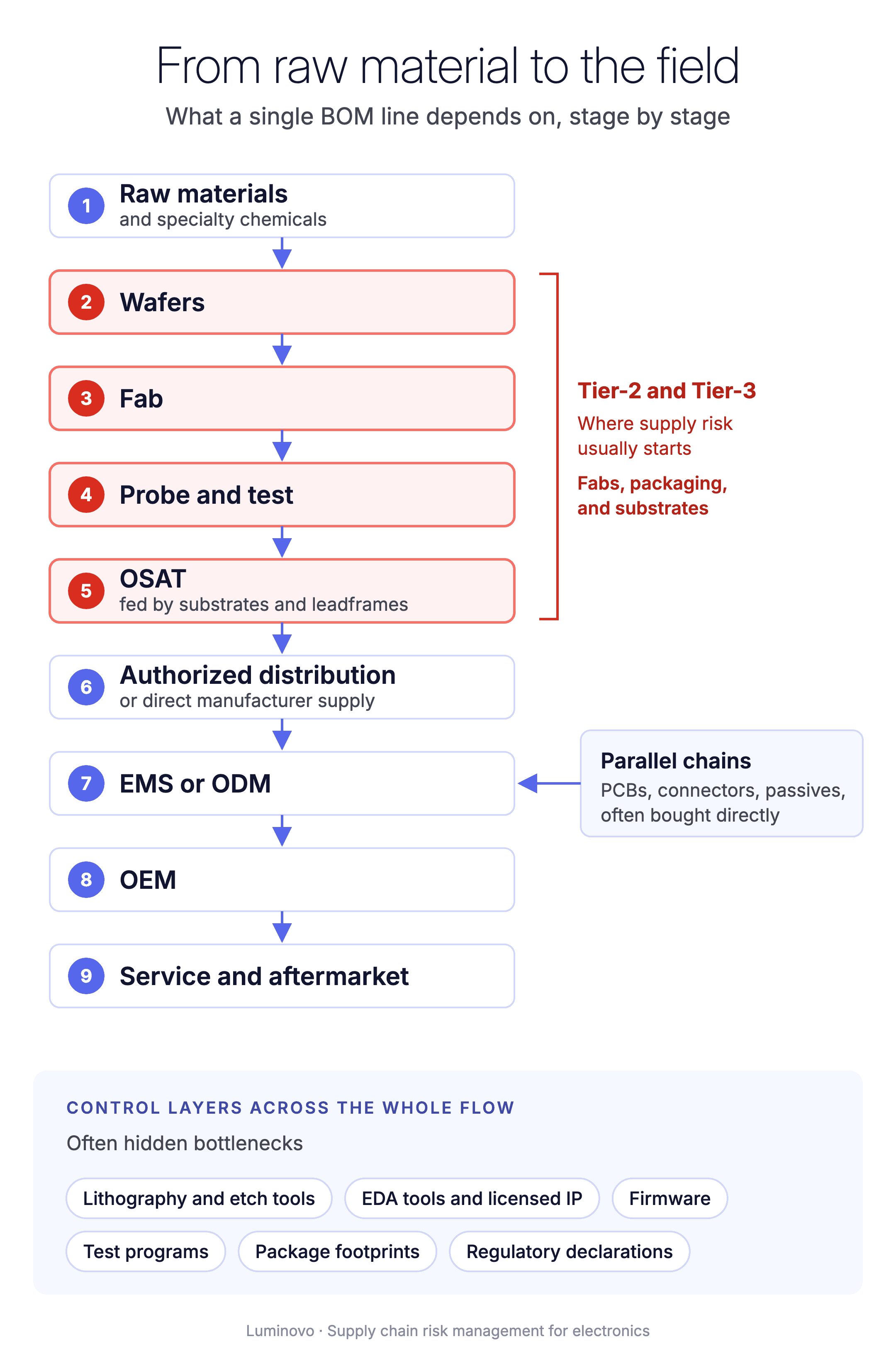
In electronics, a single BOM line can depend on upstream wafer capacity, a specific fab node, a limited-package OSAT line, substrate build-up film, a particular test insert, distributor stock, and an EMS line qualification. The chain runs, from raw material to the field:
Raw materials and specialty chemicals
Wafers
Fab
Probe and test
OSAT, fed by substrates and leadframes
Authorized distribution or direct manufacturer supply
EMS or ODM
OEM
Service and aftermarket
PCBs, connectors, and passives run as parallel supply chains, often bought directly from fabricators and manufacturers. Those dependencies are why supply chain issues in electronics rarely resolve at a single tier.
Across that flow sit control layers that often become hidden bottlenecks: lithography and etch tools, electronic design automation (EDA) tools and licensed IP, firmware, test programs, package footprints, and regulatory declarations.
The cost of changing a part
What makes electronics different from other manufacturing sectors is the qualification burden attached to change. A pin-compatible alternate often stops being a drop-in replacement in practice: small differences in package tolerances, power profile, thermal behavior, oscillator behavior, memory timing, or software support can trigger PCB revision, validation, recertification, or field-service complications. AMD’s documentation on footprint compatibility shows that compatible sourcing is decided at the design stage.
Lifecycle notices that arrive late
The same applies to lifecycle management. Two JEDEC standards still set the baseline for notice: J-STD-046 for product and process changes, and J-STD-048 for discontinuance, which is announced through a product discontinuance notice (PDN). Compliance is uneven, though, especially among passive, electromechanical, and smaller component makers.
Many component discontinuations now arrive without formal manufacturer notice (neither a PCN nor a PDN), leaving teams with less structured warning than the standards intend.
Part of the reason notices go missing is structural: formal notices go to the customer of record, and franchised distributors forward them to their buyers, often late or incompletely. An OEM whose parts its EMS buys turnkey, or that buys through brokers, often never sees them unless the EMS relays them. That is why automated lifecycle monitoring must track status changes, NRND flags, distributor stock behavior, and lifecycle forecasts, rather than wait for notices to arrive.
Contracts decide continuity
Contractually, the electronics market is also unusual. Long-term agreements (LTAs), non-cancelable, non-returnable (NCNR) provisions, allocation clauses, backlog/commit language, and volume-priority arrangements can decide continuity long before a public shortage is visible.
By December 2025, Micron had agreed price and volume for its entire calendar-2026 HBM supply and was negotiating multiyear contracts with specific commitments. Across DRAM, TrendForce reported buyers competing more aggressively for allocations in early 2026, while suppliers kept moving capacity toward server and HBM products.
In practice, “forecast discipline” has become as much a commercial control mechanism as a planning input.
🔗 Share one live view with suppliers & customers
Connect suppliers, customers, and internal teams in one real-time platform with shared workflows.
Common supply chain threat taxonomy
The table below maps the canonical risk families to electronics realities, tier exposure, and time horizon.
Risk family | In electronics | Leading signal | First action |
|---|---|---|---|
Demand risk | AI-driven mix shifts, demand front-loading, channel distortion, sudden hyperscaler pull-ins | Forecast error, booking spike, design activity, distributor depletion | Freeze assumptions on critical BOM lines and segment demand by availability class |
Supply risk | Fab bottlenecks, OSAT choke points, Ajinomoto build-up film (ABF) limits, yield and test constraints | Lead-time slope, allocation flags, wafer/package bookings | Identify shared sub-tier dependencies, qualify alternates, reserve capacity |
Geopolitical risk | Export controls, tariffs, sanctions, industrial-policy intervention, shipping choke points | Legal notices, customs changes, crisis-stage triggers, freight reroutes | Legal review, trade re-costing, geographic dual-path plan |
Regulatory and compliance risk | RoHS, REACH, and PFAS rule changes, forced-labor detentions, EU cyber rules, missing declarations | New substance thresholds, detentions, declaration expiries | Compliance refresh on top BOMs, document traceability, supplier attestations |
Operational risk | Factory outages, cyber incidents, ERP/PLM data breaks, stale approved manufacturer and vendor lists (AML/AVL) | On-time in-full (OTIF) drift, ECO latency, mismatched part records, quality alerts | Data governance, escalation, contingency build plan |
Lifecycle risk | PCN/EOL, NRND, missing notices, package migration, toolchain and firmware lock-in | PCN velocity, lifecycle forecast, manufacturer notices | Triage, qualify, LTB or redesign |
Authenticity and quality risk | Counterfeit or broker exposure, unauthorized sourcing, latent defects, quality escapes | Broker share, suspect lots, quality escapes, test failures | Authorized-only sourcing default, screening, quarantine and traceability |
Tailored risk register schema
A usable electronics risk register should track more than “supplier” and “lead time.” At minimum, it needs five groups of fields, which reflect today’s real part-level failure modes:
Part identity — internal part number, manufacturer part number (MPN), and package and footprint
Supply path — fab and node if known, OSAT or package house, substrate or leadframe dependency, country of origin and ship-from, and authorized vs. broker path
Alternates and lifecycle — AML depth, alternate and qualification status, firmware and toolchain dependency, lifecycle status, and PCN or EOL date
Commercial exposure — NCNR exposure, tariff and export-control exposure, current lead time, lead-time slope, and revenue at risk
Ownership — a named owner for every line
In practice, a part can look “dual-sourced” at Tier-1 while actually sharing the same hidden OSAT or substrate supplier across two approved manufacturers. That is why paper dual sourcing often fails under stress. Part-to-site and sub-tier mapping are more useful than supplier-count metrics alone.
Electronics supply chain risk in 2026
The highest-confidence 2026 demand signal is concentration around AI infrastructure. TrendForce reported that Taiwan Semiconductor Manufacturing Company (TSMC) projects AI-accelerator wafer demand to rise elevenfold from 2022 to 2026. It also reported that AI demand had tightened both 3 nm–2 nm wafer capacity and 2.5D/3D advanced packaging, with the CoWoS shortage spilling upstream into production equipment and downstream into substrates, packaging materials, and other critical components.
Spillovers into memory and power
The spillovers matter as much as the headline GPU story.
Memory was the tightest segment in early 2026, as DRAM suppliers kept moving advanced nodes and new capacity toward server and HBM products. Power parts followed: TrendForce expects power-management IC lead times to stretch from 21–26 weeks to 35–40 weeks. So did high-capacitance multilayer ceramic capacitors (MLCCs), where makers’ book-to-bill ratios hit post-pandemic highs. Market signals in 2026 pointed to memory price growth and renewed MLCC tightness rather than a broad-based shortage.
The 2026 market is strategically tight in a handful of AI-exposed categories, while much of the rest has normalized. A missing part from a normalized category still stops a build, so monitoring can’t stop at the tight ones.
Allocation regimes in 2026
Allocation has shifted from emergency language to a continuing commercial model in some categories, especially memory. The reason is structural and commercial: adding new capacity takes years, memory makers have held back investment since the last downturn, and wafer capacity has shifted to HBM, which consumes far more wafer per bit than standard DRAM.
Allocation is how suppliers ration what remains and also use it to price and prioritize customers.
The practical regimes now seen in the market are:
Hard allocation with supplier-controlled shipping windows
Contracted allocation with tied price/volume commitments
Informal preference allocation where supplier behavior favors strategic accounts
Distribution-mediated allocation where inventory exists, but access depends on relationships and a credible backlog
A workable “customer-of-choice” playbook in this environment comes down to six concrete behaviors:
A meaningful and growing share of the supplier’s spend
A strong design-win and design-registration position
Forecast accuracy
Fast NCNR decisions when justified
Clean debit and claim behavior
Engineering engagement on alternates and roadmap transitions
For EMS providers, allocation on customer-controlled parts often flows through the OEM’s own agreements, so the OEM’s backing for the EMS demand matters as much as the EMS relationship itself.
Those behaviors are the operational substance of supplier relationship management (SRM): risk explains why companies need to manage their supplier base, and SRM is how they do it.
ASCM’s procurement guidance reinforces the same principle: suppliers reserve flexibility for customers who remove planning volatility and commercial friction.
How long allocation will last
The memory chip shortage shows where this leads: the Korea Herald reported in August 2026 that SK hynix’s chief executive expects it to last through 2030.
The lesson for OEMs is that under persistent allocation, volume, strategic weight, and signed commitments decide each buyer’s share, and a credible forecast is what keeps a smaller buyer’s share from being cut first.
Tariffs, export controls & crisis powers
The most material policy developments for electronics leaders to monitor in 2026 are multinational in scope.
United States
In the United States, tariff policy has moved fast. Executive Order 14389 terminated tariffs imposed under the International Emergency Economic Powers Act (IEEPA) in February 2026, while expressly preserving duties resting on other authorities. Tariffs under Section 301 of the Trade Act of 1974 and Section 232 of the Trade Expansion Act of 1962 remain in place.
Related to artificial intelligence, the January 2026 Section 232 proclamation established a framework to adjust imports of semiconductors, semiconductor manufacturing equipment, and derivative products, including an immediate 25% duty on certain advanced computing chips and derivative products under specified conditions, while signaling possible broader semiconductor tariff actions.
At the same time, the Bureau of Industry and Security (BIS) moved license reviews for certain advanced computing chips exported from the US to China and Macau to case-by-case in a January 2026 rule, and its May 2026 guidance confirmed that exporting advanced computing items to entities headquartered in Country Group D:5 or Macau still requires a license.
European Union
In Europe, the Chips Act already contains a crisis-response pillar with monitoring, a semiconductor alert system, the European Semiconductor Board, and the possibility of a “crisis stage”; the Commission also ran a semiconductor supply-disruption simulation with all 27 member states in November 2025.
In June 2026, the Commission published its Chips Act 2.0 proposal, which the European Parliament and member states still have to agree on. Under the existing act, once a crisis stage is activated, the Commission can, as a last resort, require integrated production facilities and open EU foundries to accept and prioritize orders for crisis-relevant products, so European supply is exposed to intervention and subsidies.
Critical materials and equipment controls
China’s controls on gallium, germanium, graphite, tungsten, tellurium, bismuth, molybdenum, indium, and some rare-earth items have made “critical-material exposure” a live electronics risk rather than a mining-sector abstraction. The Netherlands tightened export controls on advanced semiconductor manufacturing equipment, effective April 2025, adding another layer of uncertainty for advanced fabs.
These regimes matter even for mature-node OEMs because they can affect tool service, materials, pricing, and midstream availability, not only frontier AI accelerators.
When a government intervenes in one supplier
Government action can also hit a single supplier directly, and the damage lands unevenly across OEMs, EMS providers, and PCB makers. The Nexperia episode is a recent worked example: a Dutch government intervention in the company and a retaliatory Chinese export ban on its China-assembled output cut supply without any material or equipment control involved.
Category heatmap
Category | 2026 posture | Why it matters now | Practical response |
|---|---|---|---|
HBM and server DRAM | Severe | Allocated supply, multiyear commitments, AI crowd-out | Lock contract cover, prioritize uses, pre-qualify alternate densities and modules; HBM comes only via the accelerator vendor |
Advanced packaging and CoWoS-class services | Severe | Bottleneck shifted downstream from wafers to packaging | Secure allocation from the accelerator vendor and lock delivery dates; only direct silicon customers can reserve capacity |
ABF substrates and packaging materials | High | Packaging expansion pulls substrates and materials | Identify shared substrate exposure, add supplier/site mapping |
Power semiconductors and power passives | High | AI data-center build-out raises server and power infrastructure demand | Buffer selectively, secure alternates, split demand by program criticality |
High-CV MLCCs | High | AI server content and selective tightness | Pre-qualify alternates, widen spec bands where safe |
MCUs and embedded processing | Medium | Normalized versus crisis years, but still exposed to package and tariff shocks | Watch lead-time slope and package-specific scarcity |
Analog and standard logic | Medium | Selective tightness, occasional supplier disruptions | Maintain alternates and monitor package constraints |
General connectors/interconnects | Medium | Metal-cost and demand pressure more than broad shortage | Hedge long-commit programs, track pricing separately from lead time |
The best way to triangulate this heatmap is to require three lenses before changing policy: a statement from the original component manufacturer (OCM) or distributor, an independent market signal, and your own demand and consumption data.
For example, check supplier claims of normalization against ECIA’s Industry Pulse lead-time survey, distributor inventory behavior, and your own commit volatility. That prevents overbuying in a tariff-frontload market and underbuying in a structurally allocated market.
2026 watchlist
Risk theme | Leading indicator | Data source | Trigger |
|---|---|---|---|
Memory allocation deepens | HBM and DRAM price and allocation-only contract signals | Micron investor relations, TrendForce, Wall Street Journal | Any critical memory line marked allocation-only for two consecutive reviews |
Packaging bottleneck migrates upstream | CoWoS queue growth, substrate tightness | TrendForce, TSMC, SEMI | 20%+ increase in package lead time or capacity reservation refusals |
Tariff repricing shock | New Section 232 scope, broker price jumps | Federal Register, White House, customs broker | BOM re-cost >3% on critical product family |
Export-control denial risk | BIS guidance/rule change, license delays | BIS, legal counsel | Any affected item lacks classification and routing rule within five business days |
Forced-labor or compliance interruption | Detentions, declaration gaps, supplier slow responses | US Customs and Border Protection (CBP), supplier portal, risk-intelligence feeds | Missing declaration on top-50 revenue parts beyond review deadline |
Lifecycle surprise | PCN velocity, EOL without notice | Manufacturer PCN/PDN systems, part-lifecycle data providers, distributor notices | Any top-25 part enters NRND/EOL without qualified alternate |
Legacy-node EOL accelerates | EOL notices on mature-node parts arriving ahead of published roadmaps | Manufacturer PCN systems, distributor notices | A top-25 legacy-node part gets an EOL notice with a buy window shorter than your redesign time |
Logistics reroute | Suez/Red Sea/Hormuz disruption | Freightos, carriers, forwarders | Transit-time variance >30% on critical lanes |
Visibility as the foundation
Supply chain visibility in electronics must be multi-tier, starting at the part level and extending to the site level. Supplier names alone are insufficient because multiple approved sources can collapse into a single hidden fab, OSAT, substrate supplier, or even a toolset dependency.

Best practice is to combine three methods, knowing each has limits:
Supplier questionnaires for declared dependencies. Component manufacturers often decline to name fab or assembly sites, or disclose them only under a nondisclosure agreement.
Site-level evidence from PCN site changes, qualification reports, country-of-origin data, and lot or date-code markings.
External graph enrichment from specialist mapping tools and intelligence platforms.
A pragmatic mapping playbook
For most OEMs and EMS firms, the fastest path is a staged mapping program, built out from the parts that matter most:
Step | What to map first | Why |
|---|---|---|
Start with the top 25 revenue-critical parts | Highest revenue-at-risk and line-stop potential | Generates immediate resilience value |
Add package and manufacturer site | Package scarcity often breaks alternates | Distinguishes true from paper dual sourcing |
Add fab, OSAT, substrate or leadframe where known | Reveals shared chokepoints | Exposes hidden concentration |
Add compliance and origin data | Trade and forced-labor risk often attaches below Tier-1 | Prevents “sourced but not shippable” mistakes |
Add firmware/toolchain coupling | Electronics failures often arise after physical substitution | Converts sourcing decisions into buildable decisions |
Refresh monthly, and on every PCN/EOL | Static maps decay fast | Maintains decision usefulness |
Minimum viable visibility
An electronics organization should not wait for the full graph to be complete before acting. A minimum-viable visibility checklist for the top-risk BOMs is sufficient to materially improve decision-making.
Must-have field | Why it matters |
|---|---|
MPN and exact package code | Alternates often fail at package level |
Approved manufacturer and approved vendor lists | Prevents master-data drift and unauthorized buys |
Lifecycle state and last PCN/EOL event | Gives early redesign or LTB window |
Known fab/node and OSAT/package path | Reveals upstream concentration |
Compliance declarations | Prevents blocked shipments or requalification surprises |
Authorized distribution coverage | Lowers counterfeit and broker exposure |
Alternate part and qualification status | Separates theoretical from usable resilience |
Firmware/toolchain dependency | Catches “software-broken” substitutions |
NCNR and open backlog | Quantifies commercial exposure |
Revenue and customer exposure | Enables prioritization |
This level of product record control matters because BOM, PLM, and part-risk tools all depend on the same approved-source, lifecycle, and change-history data.
Real-time data feeds & governance
The most useful live electronics feeds are:
PCN and EOL notices
Distributor inventory and lead-time signals
Supplier commits and push-outs
Shipment arrival estimates and lane variance
Customs and tariff changes
Quality escapes and returns
Geopolitical and weather alerts
Internal consumption burn
External market feeds are most valuable when tied to a governed master data model instead of pulled into spreadsheets ad hoc. IPC’s sentiment reports and ECIA’s Industry Pulse show the direction, but they publish monthly or quarterly. For top-risk parts, lead times, allocation status, and distributor stock can shift within weeks, so monthly manual updates are too slow; the distributor and risk-platform APIs carry the live signal.
A good governance model treats every new signal as one of four classes: authoritative, market intelligence, supplier assertion, or internal observation. Policy or engineering decisions should require at least one authoritative source for legal/compliance changes and at least two independent sources for scarcity claims. That prevents common failure modes such as believing a supplier’s optimism after a capacity event or overreacting to a one-off broker quote.
The digital thread
The desired digital thread connects PLM, ERP, MES, quality, and SCRM, with each system owning one part of the record:
PLM — form/fit/function, approved alternates, and ECOs
ERP — purchase orders (POs), NCNR, and vendor and financial exposure
MES — lot and build traceability
Quality — nonconformance reports (NCRs), returns, and qualification evidence
SCRM — external lifecycle, supply, geopolitical, compliance, and sub-tier mapping intelligence
At an EMS, where the AML belongs to the OEM customer, an alternate becomes usable only after a customer deviation or AML change, so the thread must reach the customer’s approval step. If AML/AVL, lifecycle, and change control are scattered across disconnected systems, resilience will remain manual and slow.
In a tariff-frontload period, distributor demand, inventory, and lead-time indices can spike due to pulled-forward orders and appear to be a structural chokepoint even when underlying capacity is fine, while supplier statements can understate the real tightness. Cross-validated data is what makes visibility useful.
Resilience strategies & design tradeoffs
No single resilience strategy works best in electronics; the right lever depends on the failure mode. Temporary logistics noise often yields to inventory and rerouting.
A package or OSAT chokepoint rarely yields to rerouting; it clears through a package-qualified alternate, a redesign, the supplier qualifying a second assembly site, or contracted allocation, with inventory bridging the wait if it can be secured. Where trade policy is the constraint, geographic duality and customs engineering often matter more than extra stock.
US customs generally assigns a chip’s origin to the country where its wafer was fabricated, so moving assembly or ship-from alone may not change the duty. The strongest programs combine multi-sourcing, design-for-supply, selective buffering, and contractual reservation rather than betting on one tool.
Single sourcing and regional exposure
Single sourcing and regional exposure often sit on the same BOM lines, as the sensor maker Leuze found when it re-evaluated a product built in Asia:
“We identified components that were either unavailable in Europe or restricted to a single source. After the analysis, we found alternatives that were more cost-effective and offered better availability. This allowed us to bring production back to Germany.”
Resilience strategy decision matrix
Strategy | Best used when | Trade-off | Electronics realism test |
|---|---|---|---|
True dual sourcing | Electrical and package compatibility can be qualified | Upside: strongest continuity | Must prove distinct package/site path, not just two logos |
Buffer stock | Risk is time-bounded or lane-sensitive | Upside: fastest to execute, while supply is still buyable and, at an EMS, once the customer authorizes the liability | Avoid buffering fast-obsolescence parts without lifecycle confidence |
Last-time-buy | EOL is known and redesign is slow | Upside: buys time for installed base or certification-heavy products | Needs verified LTB window and storage controls |
Regional duality | Trade or geopolitical risk dominates | Upside: lowers policy and lane risk | Works only if data and quality processes are mirrored |
Design-for-supply | New product or mid-life redesign | Upside: structural reduction in single-point failure risk | Must include package, firmware, and test implications |
Capacity reservation or LTA | Chokepoint is known and strategic | Upside: improves priority and predictability | Effective only if forecasts are credible |
Vendor-managed inventory (VMI) or consignment | Demand is stable and supplier relationship is strong | Upside: reduces stockout risk at use point | Needs clear title, liability, and obsolescence terms |
Design-for-supply checklist
Electronics resilience is won early in the design process, so OEM resilience starts at the design stage. The most useful checklist is:
Design question | Why it matters |
|---|---|
Can the footprint accept more than one package or vendor family? | Avoids package-only lock-in |
Is there a pin-compatible or near-pin-compatible alternate? | Reduces redesign scope |
If not, can a mezzanine, daughtercard, or modular boundary isolate the risky part? | Contains future redesign cost |
Is firmware abstracted from device-specific peripherals and timing assumptions? | Makes substitutions real, not cosmetic |
Are there programmable substitutes for logic or control functions? | Adds options where exact alternates are scarce, with its own allocation and toolchain exposure |
Is performance over-specified beyond real need? | Wider spec windows increase alternate pool |
Are passives selected from dense, multi-supplier commodity families where possible? | Improves AML depth |
Are critical components placed to allow rework or package migration? | Lowers ECO and service burden |
Texas Instruments’ second-sourcing guidance and AMD’s package-footprint compatibility documentation both show why this matters: PCB layout and package planning often determine the feasibility of an alternate long before procurement is involved.
📊 See which products an EOL puts at risk
Flag lifecycle, availability, and compliance risk on every BOM, and see which assemblies each part affects.
Buffer stock policy
A defensible buffer policy should distinguish base stock from shortage-mode stock. Use the normal variability model for baseline coverage, then apply a risk multiplier only to the small set of parts with high concentration, high revenue exposure, or long requalification time. A practical policy looks like this:
Base safety stock — set by demand and lead-time variability.
Shortage-mode uplift — added when leading indicators (lead-time slope, commit slippage, distributor depletion) or a policy shock cross a threshold, before formal allocation. Once allocation is declared, you usually can’t buy extra volume, and over-ordering is treated as phantom demand. PCN and EOL exposure goes through the LTB decision, not safety stock.
Lifecycle cap — no excess buys on parts with an unstable lifecycle or a likely redesign, and no more than date-code acceptance windows, moisture-sensitivity storage limits, and solderability aging allow.
Quarterly burn-down review — excess stock released against demand and roadmap updates.
This avoids the common mistake of treating all parts as shortage parts, which usually turns resilience into dead inventory. At an EMS, any buffer or uplift above customer demand also requires written customer authorization covering excess, obsolescence, and NCNR liability; otherwise, the EMS carries the stock.
Contracting levers that matter
For constrained categories, contracting levers deserve equal weight to sourcing tactics, and the OEM–EMS agreement must reflect them: when the EMS buys turnkey, every NCNR commitment, last-time buy, or shortage buffer placed on the OEM’s forecast becomes an excess-and-obsolete liability unless the contract specifies who owns it.
In 2026, the most relevant levers are:
LTAs with explicit volume bands
NCNR clauses linked to forecast validity windows
Capacity reservations for package and test or strategic materials
VMI or consignment for stable-demand lines
Priority or escalation language tied to collaboration and commit behavior
Buyers negotiating any of the above are competing against commitments that already extend years ahead: in the tightest memory categories, non-cancelable volume is booked well beyond the usual planning horizon, and some supply agreements already run through the end of the decade. Supplier emphasis on specific commitments and multiyear discussions, combined with allocation in memory, shows that “purchase-order-only” operating models are too weak for the most constrained categories.
Passives show the same selective pressure. In August 2026, TrendForce reported MLCC lead times diverging: standard parts held at 14–18 weeks, while some high-end parts stretched to around 40 weeks. Teams with parametric-approved alternates and spec flexibility can absorb that kind of selective pressure; teams with frozen, over-tight specs cannot.
Risk scoring, KPIs, dashboards & escalation
The most useful electronics score is a stacked score reflecting four layers: category risk, supplier risk, part risk, and policy/geography risk. That structure matches how SCRM platforms do it, though differently, and aligns with the semiconductor resilience literature: risk emerges from the network, not an isolated vendor record.
Sample scoring model
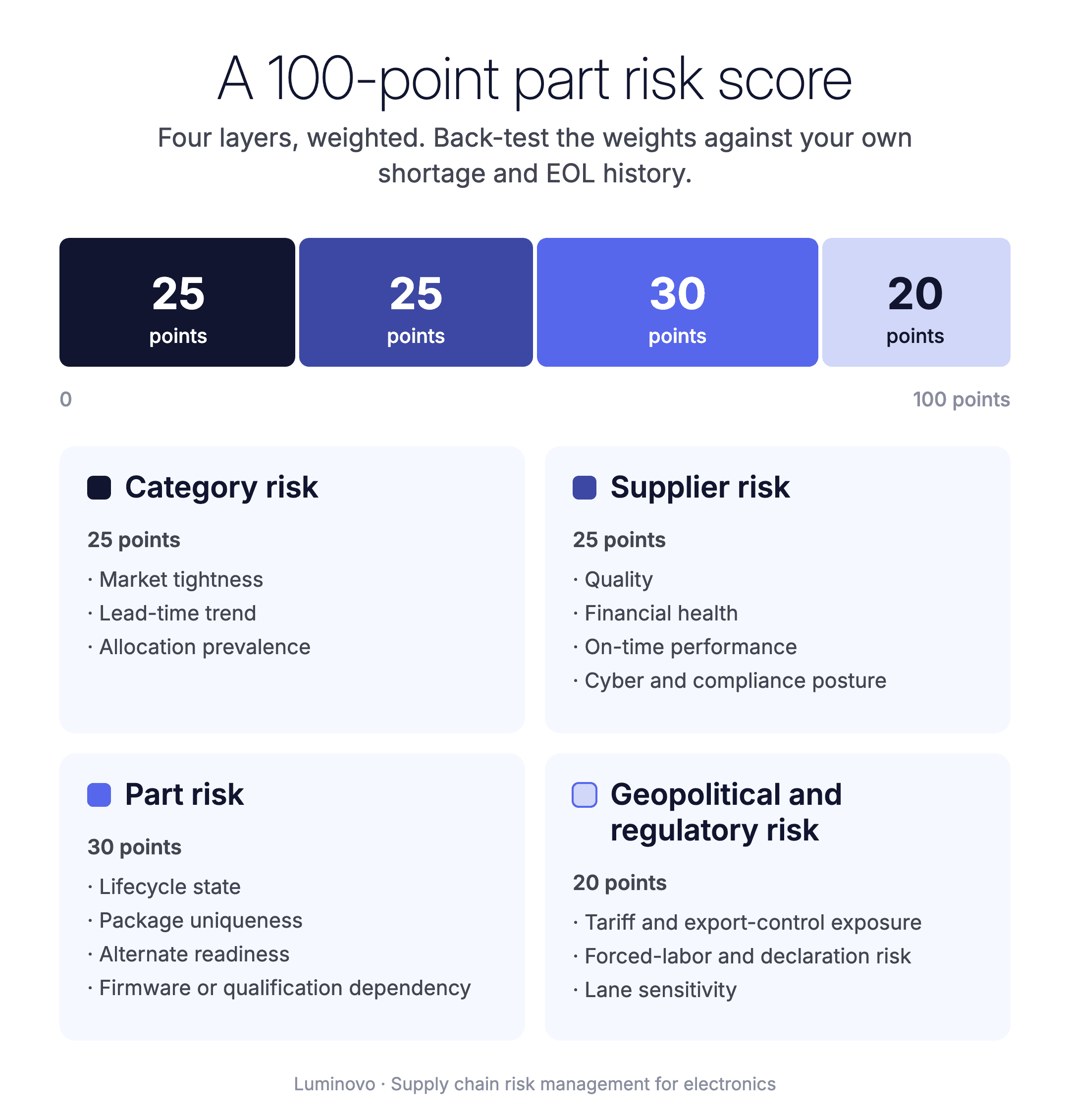
A practical 100-point model is:
Category risk (25 points) — market tightness, lead-time trend, and allocation prevalence
Supplier risk (25 points) — quality, financial health, on-time performance, and cyber and compliance posture
Part risk (30 points) — lifecycle state, package uniqueness, alternate readiness, and firmware or qualification dependency
Geopolitical and regulatory risk (20 points) — tariff and export-control exposure, forced-labor and declaration risk, and lane sensitivity
Within part risk, the most predictive electronics fields are lifecycle notice quality, package uniqueness, and qualified-alternate depth. Within category risk, the most predictive fields are lead-time slope and allocation flags.
The category emphasis matches recent allocation in memory and packaging; the part-level emphasis comes from EOL and package-migration events. The weights below map to the four layers (category 25, supplier 25, part 30, geopolitical and regulatory 20). Use them as a starting point, then back-test against your own shortage and EOL history.
Example part scorecard
Dimension | Weight | Example metric | Threshold concern |
|---|---|---|---|
Lead-time slope | 13 | Change in supplier-confirmed lead time over 30 days, in % | >20% increase in 30 days |
Allocation status | 12 | Binary or graded | Any allocation on top-25 revenue part |
Lifecycle risk | 10 | Active/NRND/EOL / no-PCN EOL trend | NRND or recent EOL family |
Alternate readiness | 8 | Qualified alternates count | No qualified alternate for a commodity part, or no mitigation plan for a sole-source part |
Package uniqueness | 6 | Unique footprint/package family | Sole package path |
Compliance exposure | 8 | Missing/aging declarations | Any gap on ship-critical part |
Authorized coverage | 6 | Authorized stock path available | Broker-only path |
Supplier operational health | 25 | OTIF, quality escapes, commit misses | Two-period deterioration |
Geopolitical/trade exposure | 12 | Tariff/export-control/lane concentration | Any controlled or repriced flow |
Scores of 0–29 mean monitor, 30–49 buyer action, 50–69 cross-functional review, and 70+ executive review and response plan. To decide which parts to work on first, weigh each score by exposure, meaning how many assemblies a part can stop and how much revenue they carry. A part that scores 60 and can stop ten assemblies comes before one that scores 70 and stops one.
Our OEM procurement playbook applies the same ranking to sourcing decisions. These cutoffs are organizational choices, but the structure holds up because it ties score movement to observable signals.
KPI set with owners & failure modes
The table below turns the scoring model into operating metrics.
KPI | Formula | Owner & cadence | Where it misleads |
|---|---|---|---|
Lead-time slope | (LT current – LT 30d ago) / LT 30d ago | Commodity manager · weekly | Supplier stops publishing or masks with “TBD” |
Commit volatility | Std. dev. of weekly commits / mean commit | Supply planning · weekly | Looks stable when demand already rationed |
Allocation flag rate | Allocated critical parts / total critical parts | Procurement · weekly | Informal allocation not formally declared |
PCN velocity | PCNs per 1,000 active MPNs | Engineering quality · monthly | Low count can hide missing notices |
EOL coverage gap | EOL parts without alternate / total EOL parts | Engineering · monthly | Alternate exists on paper but not qualified |
AML depth | Qualified sources per critical part | Component engineering · monthly | Shared sub-tier makes depth look better than reality |
NCNR at risk | NCNR value on at-risk parts | Procurement finance · monthly | Excludes future liability in backlog |
Broker dependency ratio | Broker spend / total acute-buy spend | Procurement quality · weekly | Independent-distributor stock tagged as authorized, or franchised excess-inventory programs counted as broker spend |
OTIF drift | OTIF current – OTIF trailing quarter | Supplier management · monthly | Temporary expedite masks systemic miss |
Expedite premium | Expedite/logistics premium as % of material cost | Operations finance · monthly | Normalized cost can hide service damage |
Revenue at risk | Revenue tied to open demand of at-risk part | Sales and operations planning (S&OP) / finance · weekly | Assumes no substitution or customer reprioritization |
These KPIs are useful because they split leading indicators from lagging indicators. Lead-time slope and PCN velocity provide early warning, but double-ordering inflates quoted lead times, and allocation flags usually appear only after a shortage has already started, so pair them with distributor inventory weeks and book-to-bill. OTIF drift and expedite premium tell you what already went wrong.
Dashboard views that matter
The most decision-useful dashboards in electronics are usually these four:
Dashboard | Purpose |
|---|---|
Top 25 at-risk parts | Prioritizes scarce management attention |
Single points of failure | Shows parts with low AML depth and shared sub-tier dependence |
Revenue at risk | Translates supply risk into business language |
NCNR and buffer exposure | Prevents “resilience” from becoming stranded inventory |
Part-intelligence and SCRM graph platforms all market variations of these views because they align with real decision moments in electronics programs.
Escalation policy
Level | Trigger | Response | Executive cadence |
|---|---|---|---|
Buyer action | Score 30–49 or mild KPI movement | Buyer-led watchlist and alternate check | Monthly |
Managed exception | Score 50–69, allocation on non-top part, or PCN with moderate design impact | Cross-functional review with engineering and quality | Biweekly |
War-room | Score 70+, a top-25 part on allocation, no alternate with a confirmed gap, or a trade disruption | Daily action tracker; supplier escalation; customer impact analysis | Twice weekly |
Executive crisis | Imminent line stop, major revenue at risk, export-control block, or counterfeit suspicion on critical build | Executive sponsor, legal/compliance review, scenario decisions | Daily |
The most common escalation failure is threshold inflation: teams wait for hard line-stop evidence before escalating. In electronics, by the time the line is at risk, the qualifying actions may already be too late.
The pattern of discontinuations arriving without formal notice shows why a lagging dashboard fails. If many EOL events arrive without normal notice, the program must proactively monitor alternate coverage and lifecycle forecasts, not just incoming PCN inboxes. Our PCBA obsolescence checklist quickly shows where a program stands.
Response playbooks, tooling & operating model
Response playbooks work only when decision gates are explicit. Electronics teams often know what they can do but lose time deciding who can authorize what. The four scenarios below should therefore be pre-approved with owners, along with evidence requirements and stop/go gates.
Scenario playbooks & decision gates
1. Shortage and allocation
First 24 hours — confirm exact part/package/site; freeze demand assumptions; verify authorized stock
24–72 hours — supplier escalation; screen alternates; assess broker need under anti-counterfeit controls (at an EMS, a broker buy and its price premium also need the OEM customer’s written approval before the PO is placed)
3–10 days — reallocate demand, execute expedites selectively, customer communication
Decision gate — ship with existing source, switch to alternate (at an EMS, only with the OEM customer’s approved deviation or AML update), or ration demand across programs and customers
2. PCN
First 24 hours — classify change type and affected assemblies; open impact case
24–72 hours — engineering impact analysis, supplier Q&A, qualification plan
3–10 days — secure bridge stock of pre-change material; start qualification builds and reliability testing, which often take weeks to months for fab, die, or assembly-site changes; get customer approval where the OEM owns the AML; approve the ECO and update AML/AVL when qualification closes
Decision gate — accept as-is; request samples, an extension, or a last-time buy of pre-change material; or move to a qualified alternate path
3. EOL
First 24 hours — verify LTB window, remaining stock, installed-base demand
24–72 hours — size installed-base and service demand; open the lifetime-buy versus redesign analysis with a decision date set well inside the LTB window
3–10 days — model storage, attrition, and service burden; prepare the LTB quantity (at an EMS, with the OEM customer’s written liability authorization for the NCNR buy) or redesign milestone plan for approval
Decision gate — lTB, redesign, replace product, or service strategy change
4. Geopolitical/trade disruption
First 24 hours — classify legal exposure; stop non-compliant flows
24–72 hours — reroute lanes, re-cost BOM, verify customs and license path
3–10 days — regional re-source, customer promise-date reset, contract invocation
Decision gate — continue flow, pause flow, or shift geography
JEDEC change/discontinuance standards, Microchip’s PCN/EOL policy, supply chain risk guidance from the Cybersecurity and Infrastructure Security Agency (CISA) and BIS, and counterfeiting controls under the Defense Federal Acquisition Regulation Supplement (DFARS) and the Defense Logistics Agency (DLA) all support the sequence above: classify first, contain second, decide with evidence third.
Lean RACI matrix for crisis response
In the table, A = accountable, R = responsible, C = consulted, and I = informed. The executive sponsor (C*) is consulted by default and approves at the war-room and executive-crisis levels, on major ECO costs, on last-time buy and redesign funding, and on any decision to pause flow or shift geography.
Role | Shortage | PCN | EOL | Geopolitical |
|---|---|---|---|---|
Commodity management | A/R | C | R | C |
Component engineering | C | A/R | A/R | C |
Quality and reliability | C | R | C | C |
Compliance and legal | C | C | I | A/R |
Operations/planning | R | C | C | R |
Finance | C | I | C | R |
Executive sponsor | C* | C* | C* | C* |
Supply risk briefing
Escalations move faster when every brief has the same shape: what changed, which parts and assemblies are affected and what revenue is exposed, the evidence (a supplier statement, an independent market signal, and your own demand and backlog), two or three options, a recommendation, a decision deadline, and a named owner.
⚡ Run OEM procurement from one live BOM
Source parts, compare supplier quotes, and track part risk for every product in one platform.
Software & tooling
Electronics teams should separate generic SCRM from electronics-native product continuity. The second category matters because BOM-level lifecycle and package intelligence are where many actual line-stop risks originate. The SCRM software market is broad, but the useful categories for electronics are fairly clear.
Generic supplier-risk platforms
Enterprise supplier-risk platforms focus on automated assessment, exposure calculation, issue-management workflows, and incident monitoring, scoring across operational, financial, compliance, cyber, sustainability, and geopolitical dimensions.
They are strongest when the problem is enterprise-level supplier exposure and workflow orchestration across every category a company buys. They are weakest at the part level, which, in electronics, is where the line-stop risk lies: a supplier score that isn’t connected to the BOM will not tell you that a single package has only one qualified source.
ERP & procurement backbone
The ERP and procurement backbone matters because it houses supplier masters, purchase orders, contracts, receipts, planning data, and exception workflows. An SCRM program that cannot read that data stays observational rather than operational. For most companies, the ERP layer is where risk decisions become spend decisions.
Electronics intelligence layer
This is the most underappreciated piece of the stack. Part-intelligence tools focus on BOM automation, electronic-parts databases, and lifecycle risk analysis, connecting SCRM to engineering reality: approved manufacturer parts, alternates, lifecycle status, compliance flags, and BOM-level exposure. A company without reliable part intelligence can still build decent supplier-risk dashboards, but it will struggle to answer the harder question: “Which exact assemblies fail if this part, package, PCN, or EOL event moves against us?”
Control-tower & monitoring capability
The Defense Business Board’s January 2025 supply chain illumination report points toward a modular stack with digital BOMs, selective near-real-time monitoring, and advanced analytics. This category includes shipment tracking, event monitoring, control-tower logic, risk propagation, and decision support.
The key design rule here is selectivity. The DBB explicitly argues for focusing near-real-time visibility on critical risk areas. In electronics, that usually means line-critical semiconductors, constrained passives, regionally exposed logistics lanes, and policy-driven exceptions rather than blanket monitoring of the entire catalog.
What to look for in SCRM software
The best software evaluation criteria for electronics are capability tests, starting with whether the tool supports multi-tier mapping and links suppliers to part numbers and part numbers to product BOMs. Here is a quick guide:
Capability | Why it matters in electronics | Minimum proof in demo |
|---|---|---|
BOM ingestion at MPN/package level | Risk sits below supplier name | Live upload with package-aware rollup |
PCN/EOL automation | Lifecycle change is continuous | Show notice ingestion, dedupe, assignment, closure |
Multi-tier graph with part-to-site mapping | Shared chokepoints hide sub-tier | Show one part mapped to fab/OSAT/site or raw-material node |
Parametric alternates and form-fit-function logic | Alternates must be technically usable | Show graded alternates and qualification status |
Distributor and inventory integration | Market speed matters | Show authorized-stock and lead-time overlay |
Compliance and trade content | Part may be buyable but not shippable | Show RoHS, REACH, forced-labor, and export checks on a BOM |
ERP/PLM/MES integration | Decisions fail without master-data sync | Show how an approved AML/AVL or lifecycle change reaches your PLM/ERP |
Audit trail and workflow | Crisis decisions must be reviewable | Show owner, timestamp, rationale, closeout |
Explainability | Black-box scores undermine action | Show score decomposition by part |
Security and retention | BOMs and supplier graphs are sensitive | Show role-based access and retention controls |
Electronics-native platforms cluster around these capabilities in different ways. Some center BOM and lifecycle risk, some emphasize multi-tier part-to-site mapping, some graph scoring across risk domains, and some connect design-stage BOM decisions to market signals. SiliconExpert and Accuris, two of the part-data sources Luminovo connects to, center BOM, approved-manufacturer, and lifecycle control. Luminovo’s Risk (SCRM) works at the BOM level described above: lifecycle, availability, and compliance flags on the parts in a live product.
Test vendors on your own BOM
In a demo, ask each vendor to work on one of your live BOMs with at least 500 MPNs: flag PCN, EOL, and compliance issues, rank the top ten parts by continuity risk, and explain why each proposed alternate is or isn’t suitable.
Then have them trace one critical part through its supplier, site, and sub-tier exposure. Expect the sub-tier view to stop where manufacturers stop disclosing, and ask which data source and license tier each flag comes from, especially PCNs.
Target operating model & roadmap
Time frame | What to implement |
|---|---|
First 30 days | Stand up top-25 part watchlist; define scorecard; assign owners; begin weekly risk review |
By 60 days | Visibility on top-25 parts, PCN and EOL monitoring on, shortage and PCN playbooks live |
By 90 days | Add revenue-at-risk and NCNR dashboards; pilot alternate qualification workflow; formalize executive escalation |
By 12 months | Mapping to top-100 parts and key sub-tier sites, SCRM linked to PLM and ERP, design-for-supply in product launch gates, quarterly playbook audits |
Training should focus less on tool usage and more on decision rights: who can approve broker buys, who can approve NCNR commitments, who owns alternate qualification timing, who decides customer reprioritization, and who signs off on geopolitical holds. That is where many otherwise capable programs still fail.
Fix the data before buying tools
Software alone does not create resilience. The Defense Business Board’s findings repeatedly point to mapped critical supply chains, digital BOMs, modular technology stacks, and well-governed data.
In electronics, SCRM tools work best when master data, engineering change governance, approved source lists, lifecycle monitoring, and trade or compliance attributes are already governed well enough to trust. When those foundations are weak, new tools often become expensive ways to display the same ambiguity faster.
Glossary
ABF (Ajinomoto build-up film): The insulating material used in the build-up layers of advanced chip substrates.
Allocation: A supplier rationing constrained output across customers, whether by contract, by strategic preference, or through distribution.
AML/AVL (approved manufacturer list and approved vendor list): The controlled lists that specify which manufacturer part numbers are approved for an internal part and which sources may supply them. At an EMS, the OEM customer usually controls the AML, while source selection often stays with the EMS within the customer’s authorized-channel rules.
CoWoS (chip-on-wafer-on-substrate): TSMC’s 2.5D advanced packaging technology, used to pair AI accelerators with high-bandwidth memory.
EMS/ODM (electronics manufacturing services provider and original design manufacturer): Companies that build products for OEMs, and in the ODM’s case also design them.
EOL/NRND (end of life and not recommended for new designs): Lifecycle states that signal a part is being discontinued or should stay out of new designs.
HBM (high-bandwidth memory): Stacked DRAM packaged next to AI accelerators.
Lead-time slope: The percentage change in supplier-confirmed lead time over a set period, usually 30 days; an early-warning signal for shortages.
LTA (long-term agreement): A multi-period supply contract with volume bands, pricing, and priority terms, often in exchange for volume commitments that range from rolling forecasts to take-or-pay.
LTB (last-time buy): The final order, usually NCNR, that a customer can place before a part is discontinued, sized to cover remaining production and service demand.
MPN (manufacturer part number): The manufacturer’s identifier for a part, whose full orderable form also encodes package, packaging, and grade.
NCNR (non-cancelable, non-returnable): A purchase condition common for long-lead, allocated, or special-order parts.
OCM (original component manufacturer): The company whose name and part number the component carries, and which controls its authorized sales channel.
OEM (original equipment manufacturer): The company that owns and sells the finished product, and usually controls its AML.
OSAT (outsourced semiconductor assembly and test): The providers that package and test chips after wafer fabrication.
OTIF (on-time in-full): The share of order lines delivered in full within an agreed window of a fixed baseline date, such as the customer request date.
PCN/PDN (product change notification and product discontinuance notice): The formal manufacturer notices for part changes and discontinuations, set out in J-STD-046 and J-STD-048.
PLM/ERP/MES (product lifecycle management, enterprise resource planning, and manufacturing execution system): The systems that hold the product record, the commercial and planning data, and the build record.
RACI (responsible, accountable, consulted, informed): A matrix that assigns decision rights for each response scenario.
SCRM (supply chain risk management): Identifying where supply can fail, how likely and how damaging each failure would be, what to do about it, and how fast the organization detects and responds.
SRM (supplier relationship management): How a company segments, measures, and develops its suppliers, producing the performance data that sourcing and risk decisions draw on.
Tier-1/sub-tier: Tier-1 suppliers sell to you directly; sub-tier suppliers (Tier-2, Tier-3), such as fabs, OSATs, and substrate makers, sit behind them. When you buy through distribution, the distributor is your commercial Tier-1, but the OCM still sets allocation, lifecycle status, and change notices.
VMI/consignment (vendor-managed inventory and consignment): Inventory models in which the supplier manages replenishment or retains title until the parts are used. Neither removes the buyer’s liability for excess or obsolete stock; the contract only shifts when and how much of it applies.