










You can tell a lot about an electronics manufacturing services (EMS) company by who picks up the phone at the distributors. If you’re only talking to inside sales, you’re engaged at a very different level than competitors who are professionally and socially connected to the General Manager.
For many EMS companies, franchised distributors form the core of the supply chain — yet these relationships are too often treated as a procurement-only concern. Here, we show why EMS executives seeking to deliver maximum value to customers should invest in strong distributor relationships.
Franchised distributors are a two-sided business
Franchised distributors run a two-sided business. On one side, they fulfill your demand. On the other, they’re responsible for driving demand toward their franchised lines. That tension shapes everything: pricing, allocation, support, and who gets a call back when supply tightens.
If you align with the distributor’s dual mission rather than ignore it, you’ll find your access and strategic support change. Ultimately, your ability to ship on time at the best cost will change, too.
Two franchised distributor types: transactional vs. strategic
Not all franchised distributors play the same game, and treating them as interchangeable is where many EMS companies begin to lose leverage.
Transactional distributors
DigiKey and Mouser are good examples of transactional distributors. These distributors are optimized for:
Small-lot purchases
Immediate availability
Fast fulfillment
They are excellent for prototyping, engineering builds, and “I need this tomorrow” situations. But they are not designed to support long-term cost optimization or allocation strategy.
The keys to a good relationship with transactional distributors are pretty straightforward:
Excellent payment history
Give them up-to-date financial information (ratios are fine if sensitive)
Minimize returns
If most of your spend sits here, you are paying for convenience and probably focused on quick-turn/NPI. Production volume is a very different game; now you need strategic partners.
Strategic distributors
Arrow and Avnet sit on the strategic end of the spectrum. They focus on:
Forecast-driven supply
Design support
Manufacturer alignment
Program-level pricing
They care more about where your demand is going than about what you need today. If you can demonstrate credible volume and continuity, they will invest time and offer much greater commercial flexibility.
There are also hybrid distributors like Newark, operating somewhere between transactional and strategic. The distinction is important to keep in mind to maximize the return on your relationship investments.
The company’s strategic initiatives include … shifting toward an increased mix of higher-margin value-added services … which generally leads to longer and more profitable relationships with the company’s suppliers and customers.
Climbing the relationship ladder: from inside sales to general manager
Who you have access to at a distributor is the clearest signal about where you stand.
Inside sales
Inside sales handles quotes, order entry, and day-to-day transactions. They are responsive and helpful, but they don’t control pricing strategy or allocation decisions.
If this is your only touchpoint, you are operating at the surface level.
Outside sales
Outside sales is looking for top-line sales first, closely followed by profit margin. They are charged with assessing your revenue potential and credibility. Remember, these people are also talking directly to your OEM customers.
They’re paying attention to:
Your growth potential, AKA your total available market (TAM)
Your margin profile
Your credibility as a customer
They act as a gatekeeper to internal resources. If they believe in your account, you get special attention instead of generic treatment.
Manufacturer reps
These are often overlooked.
Manufacturer reps, or direct salespeople, care most about design wins and long-term demand creation. If your engineering team is engaged and specifying their lines, your leverage improves quickly. You may get introduced to Product Managers and other key players at the manufacturer who control pricing, allocation, and product roadmaps.
This is how you move from being a simple buyer to strategically aligning with the demand creation engine.
Sales managers & general managers
At this level, the conversation shifts.
Now you are talking about:
Market share
Strategic accounts
Long-term positioning
These roles can influence pricing structures, stocking programs, and internal prioritization. They decide which customers get support when supply gets tight. Need a bigger credit line? If you’re key to a General Manager making their revenue forecast, and they believe in you, you have a friend with the credit department.
If no one at this level knows your name, you are definitely at a disadvantage when competing against much better-connected rivals.
⚡ Quote faster, win more deals
Pull live distributor pricing, lead times, and lifecycle alerts into the quoting workflow your team already uses.
👉 See how it works
What strong distributor relationships unlock
The value of these relationships comes down to access. The wider and deeper your relationships, the more access you have to pricing, terms, inventory, and information that is simply not available through transactional channels. This is supplier relationship management (SRM) in practice, turning spot demand into program business.
There are two frameworks from sales and supplier management thinking that help make this tangible: The Power Map, commonly associated with Miller Heiman and MEDDIC-style enterprise sales methodologies, and The Trust Equation, widely used in supplier relationship management and procurement.
The Power Map: Who you know & where they sit
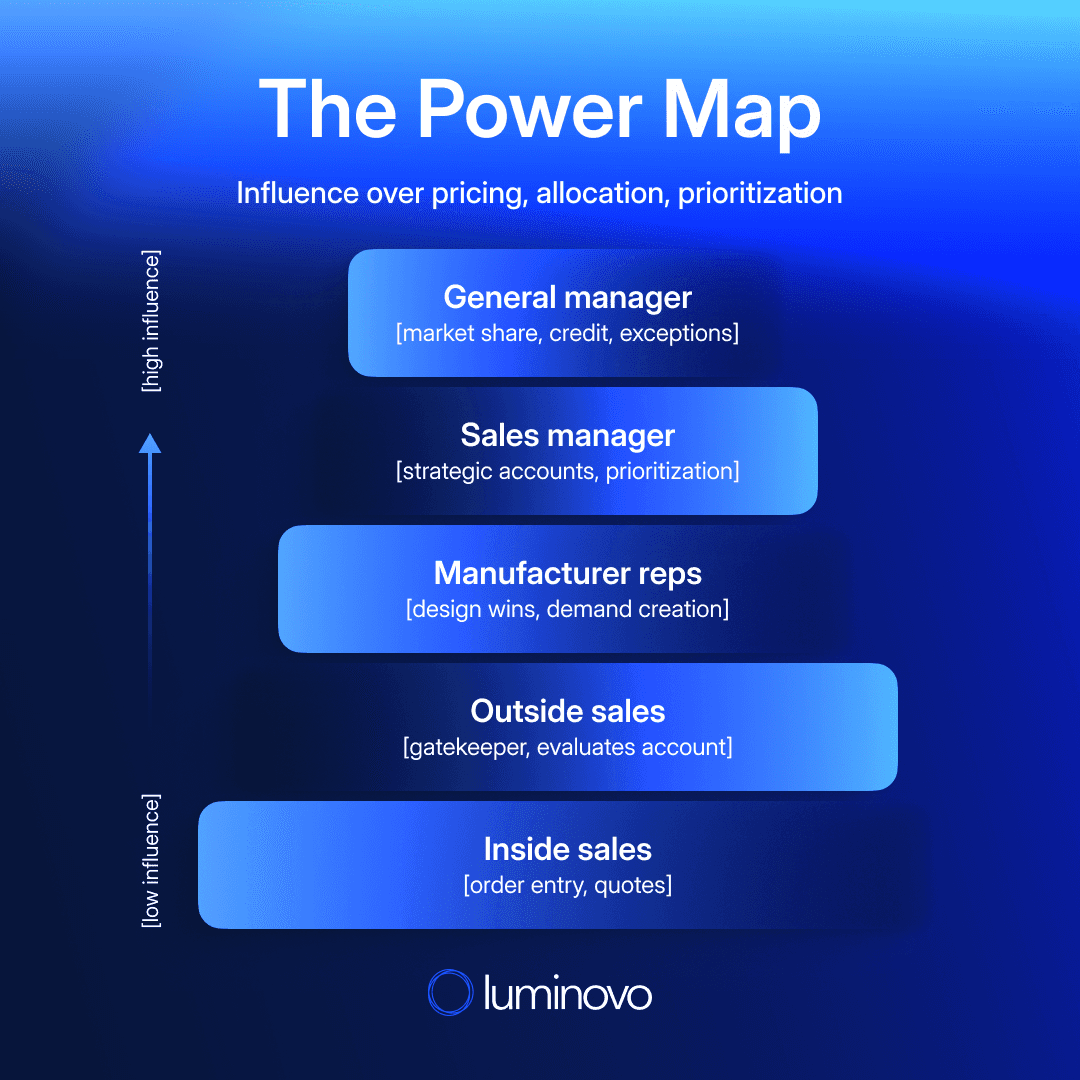
The Power Map is about coverage. If all your relationships live with inside sales, you’re covered at the lowest level of influence — order entry, quotes, day-to-day transactions. Real leverage starts when your relationships extend to outside sales, product specialists, sales managers, and general managers; these are the people who actually shape pricing, allocation, and prioritization.
The Trust Equation: Do distributors believe in your account?
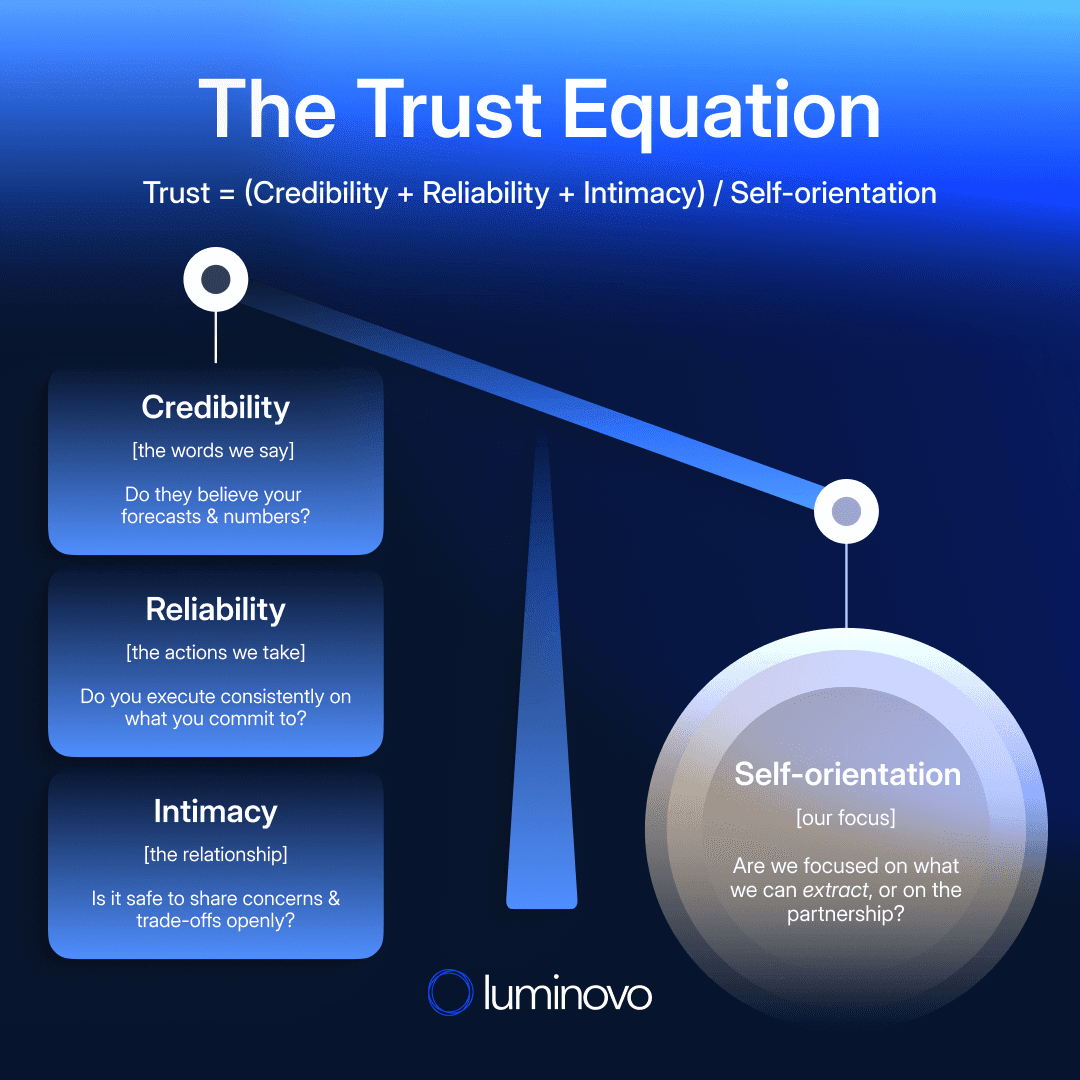
The Power Map gets you in the room. The Trust Equation is what happens once you’re there. Do distributors believe your forecasts, trust your execution, and see long-term value in your account?
If the answer is no, access stays limited, no matter how many contacts you have. If the answer is yes, doors open quickly: better pricing, better terms, earlier signals.
With Power Map coverage and Trust Equation credibility in place, the benefits show up in concrete, measurable ways.
Where strong relationships pay out
Pricing
Distributor pricing has two components: cost and margin. You need to be sure you’re getting access to the best of both.
Cost comes from the manufacturer — For production volumes, pricing is driven by factory programs, design registration, forecast credibility, and where your demand sits in the supplier’s priorities. Strategic distributors are the conduit to those programs. They’re crucial advocates for your account, aligning your forecasts with the factory and helping you qualify for the most favored pricing tiers. If you’re treated as spot demand, you get spot pricing. If you’re treated as program business, your cost basis changes.
The distributor decides margin — Strategic relationship value shows up quickly when distributors apply margin. The same line card, the same part, the same volume can carry very different margins depending on how your account is perceived. Strong relationships reduce unnecessary margin stacking, open the door to rebates, and create flexibility when you need exceptions.
Many EMS teams focus on unit price without asking which side of the equation is driving it: cost or margin? That is how you end up negotiating pennies on margin while missing dollars on cost.
📊 Optimize production with real-time insights
Analyze costs, processes, and materials to improve efficiency and margins.
Terms
Cash flow often matters more than most sourcing teams admit. Flexible terms also allow an EMS to offer better terms to your customer or hold more inventory to meet unexpected customer demand.
Strong distributor relationships can provide:
Extended payment terms
Credit line flexibility
Volume rebates
These are negotiated based on trust, consistency, and perceived future value.
Stocking programs
Stocking programs are operational territory. With the right relationship, you can access:
Vendor Managed Inventory (VMI)
Bonded inventory
Consignment inventory
These models shift inventory risk off the EMS balance sheet while simultaneously improving availability. They also require close alignment on forecast quality and liability; otherwise, they become excess and obsolete problems.
Market intelligence
General commodity trends are interesting, but strong relationships can unlock the most powerful market intelligence: your local market.
Your EMS business operates within a geographic area. The OEM customers you serve are regional. Your competitors are regional. Distributors sit across all of it.
They know:
Which startups just raised funding
Which OEMs just landed a major program
Which companies are ramping and pulling in orders
Which programs are stalling or getting canceled
They hear this because they speak with dozens, or even hundreds, of accounts in your region every week. Their communication surface area is far wider than yours.
That makes them a steady source of early signals. Real-world tip-offs about who is about to need capacity, who is about to struggle, and where demand is shifting.
During the last semiconductor shortage, inventory buffers dropped to dangerously low levels, in some cases below five days, according to the U.S. Department of Commerce. In that kind of environment, knowing where demand is building locally can directly influence who you pursue and how you allocate your own capacity.
If your distributor only calls you after lead times spike, you’re already behind. Strong relationships flip that — you get the early signals before the market does.
Distributors are one source of market signals; your sourcing platform is the other. Tools like Luminovo’s Procurement Intelligence aggregate live distributor pricing, lead times, and lifecycle alerts in one place. This way, the signals don’t sit in someone’s inbox or get missed across spreadsheets.
Distributors are one source of market signals; your quoting workflow is the other. Tools like Luminovo’s Quoting Intelligence bring live distributor pricing, lead times, and lifecycle alerts inside the quotes your team is already building — so the signals don’t sit in someone’s inbox or get missed across spreadsheets.
Manufacturer access
Distributors often act as the eyes and ears of manufacturers. Strong distributor relationships improve your access to:
Direct manufacturer support
Factory allocation
Engineering engagement
Most favored pricing
This matters when supply tightens or when you need exceptions. It also reduces the temptation to go to the open market, where counterfeit risk is significantly higher, as documented in U.S. Senate investigations into electronic component supply chains.
Favored access through strong, direct relationships with semiconductor manufacturers signals to OEMs that you’re a serious, long-term partner.
Our customers appreciate when we point out discontinued components and propose alternatives. It helps them avoid costly redesigns and strengthens our customer relationships.
— Tobias Schöppner, Strategic Purchasing & Procurement at kessler systems
Benchmarking your relationships
Skip scorecards; you can assess your relationships fast if you know what to look for.
How well do you know distributor management? This is the fastest gut check.
Do you have their mobile number?
Can you call them after hours?
Do they answer, or how quickly do they call you back?
If the answer to these is no, you’re not as connected as you need to be. Strong relationships show up in access and responsiveness.
What are your customers telling you about your pricing? This is one of the clearest signals. Are customers consistently saying your quotes are 10–15% high? Or are you off by 20% or more?
If you’re within 10–15%, you likely have a distributor margin issue. That is relationship-driven and fixable.
If you’re off by 15–20% or more, that usually points to cost, not margin. You’re not getting access to the right manufacturer programs or pricing tiers.
Are you actually getting the benefits? This is the simplest test. Strong relationships show up in outcomes.
Are you getting better-than-net-30 terms?
Are they proposing VMI, bonded, or consignment programs?
Are you being introduced to manufacturer contacts?
Are you getting pulled into opportunities where you can compete above your weight?
If none of this is happening, the investment isn’t paying out — and it’s worth a conversation about why.
When these relationships are working, you can see it in the commercials: better pricing, better terms, earlier allocation, sharper intelligence. When you can’t, the investment isn’t translating into outcomes.
Expand your Power Map coverage, so you’re connected to people with influence. Then, solve the Trust Equation by being consistent on forecasts, clean on execution, and predictable to work with. Once those are in place, access will follow.