









back to blog

ERP integration made easy: Myths and solutions

ERP integration made easy: Myths and solutions

Tech

futuristic ERP logo

We have the feeling that talking about ERP (Enterprise Resource Planning) integration is some kind of conversation stopper. It's one of those things that, if not understood properly, can create confusion and provoke reluctance towards it. 

Have you ever found yourself thinking: “Oh no, I don't even want to hear about it”, or “Not now”? Then, this blog is for you!

Let's break the bias 

First, a quick definition of ERP integration: it refers to the process of connecting your business ERP, which is THE central system holding the company master data, to other applications, with the objective of easily sharing data across systems. This connection is possible thanks to the technology of APIs (Application Programming Interfaces), which also allows it to be in real-time, guaranteeing unparalleled data accuracy.

That said, why do people hate it so much?!

If not done the right way, embarking on an ERP connection project can be very time-consuming and costly for an electronics business, whose focus and expertise is (and should be) in building electronics, certainly not in connecting external software systems. The lack of internal know-how often calls for either expensive external ERP consultants, or a considerable amount of time and effort from the in-house IT department. 

But it doesn't have to be an either/or situation only leading to loss: if done the right way, it's a project that will open up success and growth opportunities for your business.    

Benefits for your business

For a business to succeed in today's electronics industry, two things are key: speed and accuracy. A great first step towards it is to rely on modern software. The second step is to connect your ERP system to the software application(s) you need.

We've said that valuable data exists in the ERP system, but it's often hidden or unstructured, and can't be used to its full potential. Transferring this information to smart systems, such as Luminovo, can help you make this data usable.

The moment you connect your ERP system to Luminovo, your ERP information (i.e. internal part numbers or IPNs, stock and pricing data) becomes available in our software, making the entire request for quotation process smoother and faster than ever. 

So, let's see how the process of integrating your ERP system into Luminovo is smooth and fast, too. 

What the process actually looks like

First, you should know that the transferred data is totally secured based on modern security standards.

Second, you should be aware that the integration process is fully supported by our Luminovo ERP expert and the Customer Success Manager of reference, with the aim of achieving the best usage of existing data.

Integration via REST API (recommended)

For the sake of this guide, we’ll solely focus on the integration via REST API, which is the industry standard and more modern way to go about it; it supports multi-site stock and more specification values for the transferred data.
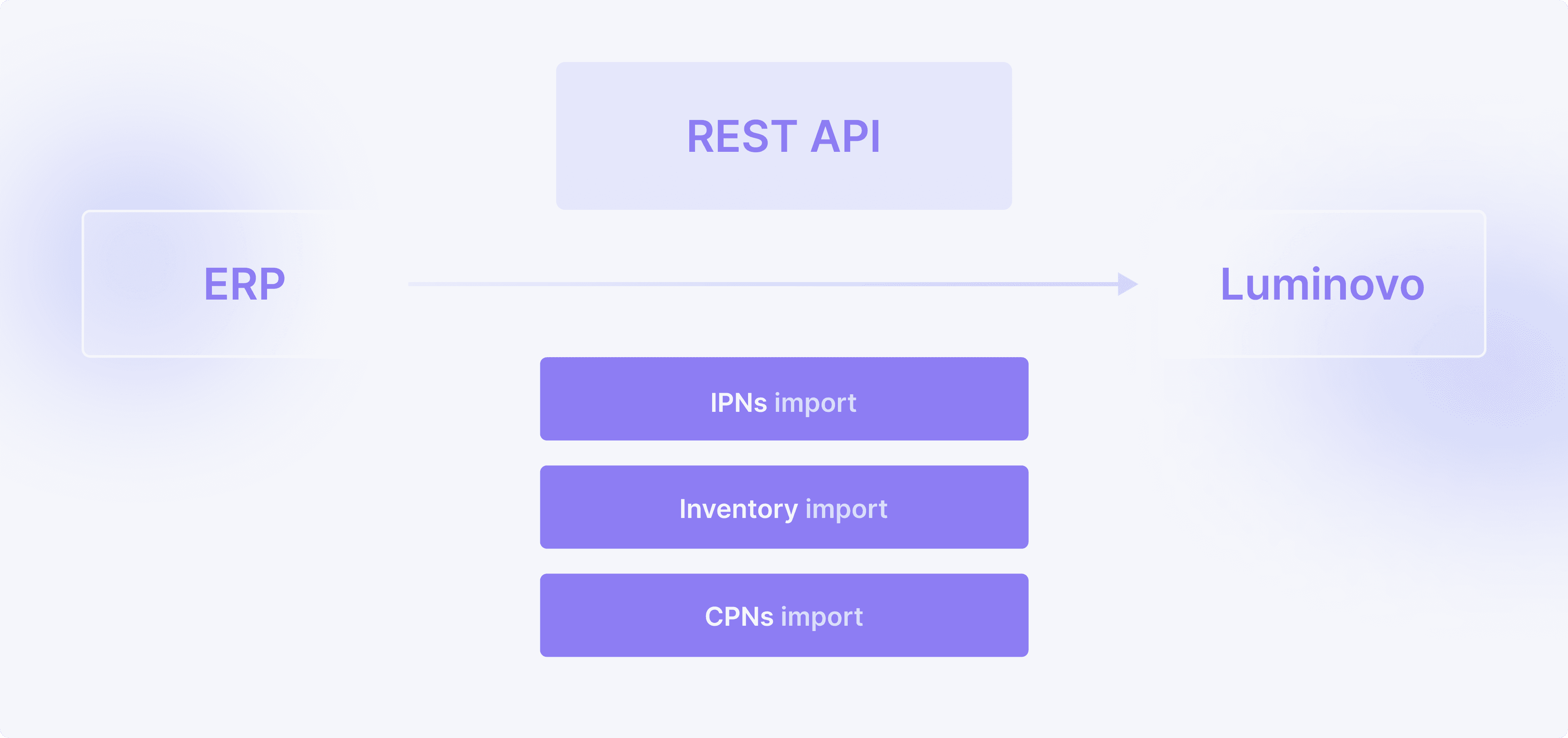
ERP rest API Luminovo workflow


The process involves four actors – the customer (you), the customer's IT department, the Luminovo Customer Success Manager (CSM), and Luminovo's ERP expert – and a total of six steps:

  1. Pre kick-off meeting between customer and Luminovo CSM.

  2. Customer fills out integration onboarding sheet.

  3. ERP integration kick-off meeting between customer IT and Luminovo ERP expert.

  4. Customer IT creates connection to Luminovo REST API.

  5. Validation meeting between customer IT and Luminovo CSM.

  6. Final meeting between customer and Luminovo CSM to confirm successful integration.


What this structure has been able to achieve is a smooth process, with very limited action items required from the customer, and the main work taken care of in the background for you.

Customer testimonial

We've asked Sebastian Bernstein, Sales Manager at Stern-Elektronik GmbH, who recently went through the ERP integration process with us, to tell you about their experience.

What is your role at Stern, and what was your role in the ERP Integration project?

I mainly work in sales, but I also dedicate myself to various topics in purchasing; I create calculations and deal with various projects. We got in contact with Luminovo at electronica 2022 in Munich and decided to work together right at the trade fair. In the following weeks, I introduced them to our house. In this context, the question of ERP integration came up, and I established the contact between our ERP service provider, PLANAT GmbH, and Luminovo.

Why did you decide for the ERP connection? What advantages do you see in the connection?

The connection of Luminovo to our ERP system is essential for our daily work. Through the connection and the associated daily synchronisation of our database, we can see our internal stock in Luminovo, and effectively take it into account when making calculations; whereas, before the integration, we had to deal with a significant amount of additional time to carry out inventory checks. So, one of the biggest advantages definitely is the time we save.

How complex or time-consuming was the ERP connection process?

In my opinion, the process of connecting our ERP system to Luminovo wasn't complex or time-consuming at all. Actually, I'd like to thank our Luminovo contact, Mr. Minor, and our ERP service provider, PLANAT GmbH: they worked brilliantly together in the background, only involving me when necessary, for a total of two Teams meetings and a few emails.

How was the support you received from Luminovo?

The support from Luminovo was uncomplicated, competent, and smart. We were completely satisfied with the support during the whole integration process.

Would you recommend this process?

I would definitely recommend the process to every Luminovo customer, because it can significantly increase productivity within the team. In addition, the integration process is very well accompanied and supported by Luminovo.

Get ready for take-off

Integrating your ERP system with the applications you need, such as Luminovo, can make a real difference in the improvement of your daily business operations. We hope this blog has showed you how!

Our Partnership Manager, Nils Minor, is happy to give you personalised advice on the topic, so please don't hesitate to drop him a line at nils.minor@luminovo.com.

Alternatively, start by browsing our partner page and scroll down to “ERP partners” to learn what we can do for you.

We have the feeling that talking about ERP (Enterprise Resource Planning) integration is some kind of conversation stopper. It's one of those things that, if not understood properly, can create confusion and provoke reluctance towards it. 

Have you ever found yourself thinking: “Oh no, I don't even want to hear about it”, or “Not now”? Then, this blog is for you!

Let's break the bias 

First, a quick definition of ERP integration: it refers to the process of connecting your business ERP, which is THE central system holding the company master data, to other applications, with the objective of easily sharing data across systems. This connection is possible thanks to the technology of APIs (Application Programming Interfaces), which also allows it to be in real-time, guaranteeing unparalleled data accuracy.

That said, why do people hate it so much?!

If not done the right way, embarking on an ERP connection project can be very time-consuming and costly for an electronics business, whose focus and expertise is (and should be) in building electronics, certainly not in connecting external software systems. The lack of internal know-how often calls for either expensive external ERP consultants, or a considerable amount of time and effort from the in-house IT department. 

But it doesn't have to be an either/or situation only leading to loss: if done the right way, it's a project that will open up success and growth opportunities for your business.    

Benefits for your business

For a business to succeed in today's electronics industry, two things are key: speed and accuracy. A great first step towards it is to rely on modern software. The second step is to connect your ERP system to the software application(s) you need.

We've said that valuable data exists in the ERP system, but it's often hidden or unstructured, and can't be used to its full potential. Transferring this information to smart systems, such as Luminovo, can help you make this data usable.

The moment you connect your ERP system to Luminovo, your ERP information (i.e. internal part numbers or IPNs, stock and pricing data) becomes available in our software, making the entire request for quotation process smoother and faster than ever. 

So, let's see how the process of integrating your ERP system into Luminovo is smooth and fast, too. 

What the process actually looks like

First, you should know that the transferred data is totally secured based on modern security standards.

Second, you should be aware that the integration process is fully supported by our Luminovo ERP expert and the Customer Success Manager of reference, with the aim of achieving the best usage of existing data.

Integration via REST API (recommended)

For the sake of this guide, we’ll solely focus on the integration via REST API, which is the industry standard and more modern way to go about it; it supports multi-site stock and more specification values for the transferred data.

ERP rest API Luminovo workflow


The process involves four actors – the customer (you), the customer's IT department, the Luminovo Customer Success Manager (CSM), and Luminovo's ERP expert – and a total of six steps:

  1. Pre kick-off meeting between customer and Luminovo CSM.

  2. Customer fills out integration onboarding sheet.

  3. ERP integration kick-off meeting between customer IT and Luminovo ERP expert.

  4. Customer IT creates connection to Luminovo REST API.

  5. Validation meeting between customer IT and Luminovo CSM.

  6. Final meeting between customer and Luminovo CSM to confirm successful integration.


What this structure has been able to achieve is a smooth process, with very limited action items required from the customer, and the main work taken care of in the background for you.

Customer testimonial

We've asked Sebastian Bernstein, Sales Manager at Stern-Elektronik GmbH, who recently went through the ERP integration process with us, to tell you about their experience.

What is your role at Stern, and what was your role in the ERP Integration project?

I mainly work in sales, but I also dedicate myself to various topics in purchasing; I create calculations and deal with various projects. We got in contact with Luminovo at electronica 2022 in Munich and decided to work together right at the trade fair. In the following weeks, I introduced them to our house. In this context, the question of ERP integration came up, and I established the contact between our ERP service provider, PLANAT GmbH, and Luminovo.

Why did you decide for the ERP connection? What advantages do you see in the connection?

The connection of Luminovo to our ERP system is essential for our daily work. Through the connection and the associated daily synchronisation of our database, we can see our internal stock in Luminovo, and effectively take it into account when making calculations; whereas, before the integration, we had to deal with a significant amount of additional time to carry out inventory checks. So, one of the biggest advantages definitely is the time we save.

How complex or time-consuming was the ERP connection process?

In my opinion, the process of connecting our ERP system to Luminovo wasn't complex or time-consuming at all. Actually, I'd like to thank our Luminovo contact, Mr. Minor, and our ERP service provider, PLANAT GmbH: they worked brilliantly together in the background, only involving me when necessary, for a total of two Teams meetings and a few emails.

How was the support you received from Luminovo?

The support from Luminovo was uncomplicated, competent, and smart. We were completely satisfied with the support during the whole integration process.

Would you recommend this process?

I would definitely recommend the process to every Luminovo customer, because it can significantly increase productivity within the team. In addition, the integration process is very well accompanied and supported by Luminovo.

Get ready for take-off

Integrating your ERP system with the applications you need, such as Luminovo, can make a real difference in the improvement of your daily business operations. We hope this blog has showed you how!

Our Partnership Manager, Nils Minor, is happy to give you personalised advice on the topic, so please don't hesitate to drop him a line at nils.minor@luminovo.com.

Alternatively, start by browsing our partner page and scroll down to “ERP partners” to learn what we can do for you.

Plug Luminovo into your ERP

Quoting and sourcing synced with your ERP, without rip-and-replace or double entry.

Plug Luminovo into your ERP

Quoting and sourcing synced with your ERP, without rip-and-replace or double entry.

Plug Luminovo into your ERP

Quoting and sourcing synced with your ERP, without rip-and-replace or double entry.

Frequently asked questions

What is ERP integration?

ERP (enterprise resource planning) integration is the process of connecting your ERP — the central system that holds company master data — to other applications so data flows between them automatically. It is usually done through APIs (application programming interfaces), which move the data between systems and keep it accurate without manual exports.

Why does ERP integration matter for an electronics business?

ERP integration matters for an electronics business because speed and accuracy depend on the data locked in the ERP, and integration makes that data usable in the tools you quote and procure with. Without it, teams rekey internal part numbers, stock, and pricing by hand, which is slow and error-prone.

How does ERP integration work?

ERP integration connects the ERP to another application through an API, so records such as stock and pricing sync between the two systems on a set schedule rather than being exported and re-entered. A modern REST (representational state transfer) API is the industry-standard method, and it can carry richer data than older file-based approaches — stock levels across multiple sites, for example.

What data does connecting your ERP to a quoting platform make available?

Connecting your ERP to a quoting platform surfaces master data like internal part numbers (IPNs), stock levels, and pricing inside the tool you quote from. In solutions like Luminovo’s, that data flows into the request-for-quotation (RFQ) process, so quotes reflect real internal stock and cost instead of a separate manual check.

Is ERP integration complex and time-consuming?

No, ERP integration does not have to be complex or time-consuming — done the right way, most of the work happens in the background between the software vendor and your ERP contacts, with limited action from your team. Done the wrong way, without support or a clear process, it can turn into a costly, drawn-out IT project.

What does a typical ERP integration process look like?

A typical REST API integration runs through a short sequence: a pre kick-off and kick-off between your team, your IT, and the vendor’s ERP expert, then your IT connects to the vendor’s API, followed by validation and a final confirmation. The vendor’s ERP expert and customer success manager (CSM) guide each step so the customer’s effort stays small.

Do you need in-house IT expertise or expensive consultants for ERP integration?

You do not usually need expensive consultants or deep in-house IT expertise for ERP integration. The reluctance usually comes from expecting exactly that cost, but a well-supported REST API process keeps the customer’s involvement to a few meetings and emails. The vendor’s ERP expert guides your IT through the technical work step by step.

Is ERP integration secure?

Yes, ERP integration is secure when it follows modern security standards, with the transferred data protected in transit and at rest. A reputable provider builds the connection so that only the agreed master data is shared.

What are the main benefits of ERP integration?

The main benefits of ERP integration are faster, more accurate work: master data that once sat siloed in the ERP becomes usable, which makes processes like quoting smoother and cuts the time spent on manual inventory and pricing checks. It removes duplicate data entry and the errors that come with it.

How do you choose the right approach to ERP integration?

The right approach to ERP integration is one built on a modern REST API and backed by a vendor that provides an ERP expert and a clear step-by-step process, rather than leaving your IT team to figure it out alone. For electronics quoting and procurement, solutions like Luminovo’s connect the ERP so the master data your quotes depend on — part numbers, stock levels, pricing — flows into the request-for-quotation (RFQ) workflow directly.

More blog articles